
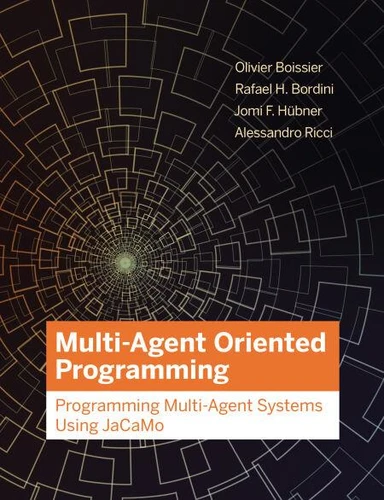
Multi-Agent Oriented Programming
Par : , , ,Formats :
Disponible dans votre compte client Decitre ou Furet du Nord dès validation de votre commande. Le format ePub protégé est :
- Compatible avec une lecture sur My Vivlio (smartphone, tablette, ordinateur)
- Compatible avec une lecture sur liseuses Vivlio
- Pour les liseuses autres que Vivlio, vous devez utiliser le logiciel Adobe Digital Edition. Non compatible avec la lecture sur les liseuses Kindle, Remarkable et Sony
- Non compatible avec un achat hors France métropolitaine
 , qui est-ce ?
Notre partenaire de plateforme de lecture numérique où vous retrouverez l'ensemble de vos ebooks gratuitement
Pour en savoir plus sur nos ebooks, consultez notre aide en ligne ici
C'est si simple ! Lisez votre ebook avec l'app Vivlio sur votre tablette, mobile ou ordinateur :

- Nombre de pages264
- FormatePub
- ISBN978-0-262-36066-1
- EAN9780262360661
- Date de parution15/09/2020
- Protection num.Adobe DRM
- Taille13 Mo
- Infos supplémentairesepub
- ÉditeurThe MIT Press
Résumé
The main concepts and techniques of multi-agent oriented programming, which supports the multi-agent systems paradigm at the programming level. A multi-agent system is an organized ensemble of autonomous, intelligent, goal-oriented entities called agents, communicating with each other and interacting within an environment. This book introduces the main concepts and techniques of multi-agent oriented programming, (MAOP) which supports the multi-agent systems paradigm at the programming level.
MAOP provides a structured approach based on three integrated dimensions, which the book examines in detail: the agent dimension, used to design the individual (interacting) entities; the environment dimension, which allows the development of shared resources and connections to the real world; and the organization dimension, which structures the interactions among the autonomous agents and the shared environment.
MAOP provides a structured approach based on three integrated dimensions, which the book examines in detail: the agent dimension, used to design the individual (interacting) entities; the environment dimension, which allows the development of shared resources and connections to the real world; and the organization dimension, which structures the interactions among the autonomous agents and the shared environment.