SOLDES
Jusqu'à -70% sur une sélection d'articles*

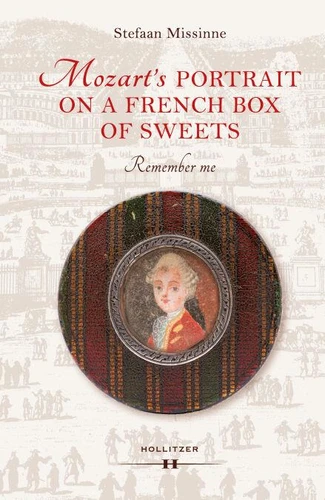
Mozart's Portrait on a French Box of Sweets. Remember me
Par :Formats :
Disponible dans votre compte client Decitre ou Furet du Nord dès validation de votre commande. Le format PDF est :
- Compatible avec une lecture sur My Vivlio (smartphone, tablette, ordinateur)
- Compatible avec une lecture sur liseuses Vivlio
- Pour les liseuses autres que Vivlio, vous devez utiliser le logiciel Adobe Digital Edition. Non compatible avec la lecture sur les liseuses Kindle, Remarkable et Sony
 , qui est-ce ?
Notre partenaire de plateforme de lecture numérique où vous retrouverez l'ensemble de vos ebooks gratuitement
Pour en savoir plus sur nos ebooks, consultez notre aide en ligne ici
C'est si simple ! Lisez votre ebook avec l'app Vivlio sur votre tablette, mobile ou ordinateur :

- Nombre de pages120
- FormatPDF
- ISBN978-3-99012-935-7
- EAN9783990129357
- Date de parution22/06/2021
- Protection num.Digital Watermarking
- Taille17 Mo
- Infos supplémentairespdf
- ÉditeurHollitzer Wissenschaftsverlag
Résumé
A portrait miniature of a cherubic boy with a wig was discovered in Salzburg in 2018. It is mounted on a bonbonnière made of papier-mâché and tortoiseshell. The provenance of the box of sweets is Paris. Could this be a portrait of W. A. Mozart from Versailles? The detective trail leads to Salzburg, Munich, Paris, and Vienna. Laboratory testing authenticates the painting and the box. Stefaan Missinne discovers the "smoking gun" in the silver frame.
The guilloche pattern is the linking orphic attribute. Facial biometrics of the boy confirm it is a ten-year-old. Mozart was ten while in Paris in 1766. The Belgian author endorses the bonbonnière as a unique Louis XV box of sweets, suggesting that it is a tribute to W. A. Mozart as an Austrian child prodigy. "An exceptional finding in a Salzburg antique shop leads, like an international research thriller, from the Mozarteum in Salzburg to the archives of the Gesellschaft der Musikfreunde in Vienna, from the Louvre and the Royal French Court in Paris to the Imperial collections of the Habsburgs.
A small, expensive and specially heralded box - the Mozart portrait box - portrays a unique, royally uniformed boyish Mozart as a composer, musician and prodigy. A wonderful artifact that allows us to sense Wolfgang Amadeus Mozart as a young Austrian musical genius. Stefaan Missinne has made a significant discovery with international appeal and world interest." Sir James Constable, Harvard University Fellow "Just as in Greek mythology Orpheus was able to sweep his fellow human beings away with his beguiling song, so the author, Prof.
Dr. Stefaan Missinne, succeeds in this compact, scientific treatise where he documents and presents striking evidence of a portrait of the youthful Mozart from Paris, dating from 1766. In so doing, he allows the striking traces and circumstances of a small, collectible, but otherwise inconspicuous artefact to speak to us and form a significant whole that addresses us today in a most meaningful way." Archduke Dr.
Michael Salvator Habsburg Lothringen
The guilloche pattern is the linking orphic attribute. Facial biometrics of the boy confirm it is a ten-year-old. Mozart was ten while in Paris in 1766. The Belgian author endorses the bonbonnière as a unique Louis XV box of sweets, suggesting that it is a tribute to W. A. Mozart as an Austrian child prodigy. "An exceptional finding in a Salzburg antique shop leads, like an international research thriller, from the Mozarteum in Salzburg to the archives of the Gesellschaft der Musikfreunde in Vienna, from the Louvre and the Royal French Court in Paris to the Imperial collections of the Habsburgs.
A small, expensive and specially heralded box - the Mozart portrait box - portrays a unique, royally uniformed boyish Mozart as a composer, musician and prodigy. A wonderful artifact that allows us to sense Wolfgang Amadeus Mozart as a young Austrian musical genius. Stefaan Missinne has made a significant discovery with international appeal and world interest." Sir James Constable, Harvard University Fellow "Just as in Greek mythology Orpheus was able to sweep his fellow human beings away with his beguiling song, so the author, Prof.
Dr. Stefaan Missinne, succeeds in this compact, scientific treatise where he documents and presents striking evidence of a portrait of the youthful Mozart from Paris, dating from 1766. In so doing, he allows the striking traces and circumstances of a small, collectible, but otherwise inconspicuous artefact to speak to us and form a significant whole that addresses us today in a most meaningful way." Archduke Dr.
Michael Salvator Habsburg Lothringen