
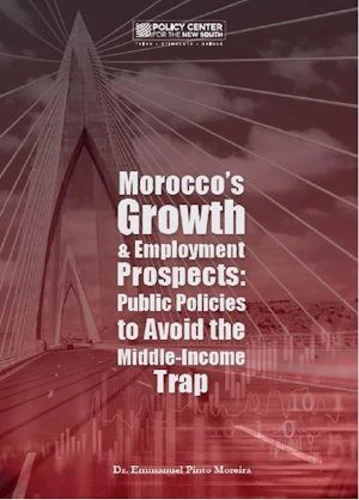
Morocco’s Growth and Employment Prospects. Public Policies to Avoid the Middle-Income Trap
Par : ,Formats :
Disponible dans votre compte client Decitre ou Furet du Nord dès validation de votre commande. Le format PDF est :
- Compatible avec une lecture sur My Vivlio (smartphone, tablette, ordinateur)
- Compatible avec une lecture sur liseuses Vivlio
- Pour les liseuses autres que Vivlio, vous devez utiliser le logiciel Adobe Digital Edition. Non compatible avec la lecture sur les liseuses Kindle, Remarkable et Sony
 , qui est-ce ?
Notre partenaire de plateforme de lecture numérique où vous retrouverez l'ensemble de vos ebooks gratuitement
Pour en savoir plus sur nos ebooks, consultez notre aide en ligne ici
C'est si simple ! Lisez votre ebook avec l'app Vivlio sur votre tablette, mobile ou ordinateur :

- Nombre de pages94
- FormatPDF
- ISBN978-9920-633-04-8
- EAN9789920633048
- Date de parution10/02/2020
- Protection num.Digital Watermarking
- Taille5 Mo
- Infos supplémentairespdf
- ÉditeurPolicy Center for the New Sout
Résumé
This book studies Morocco's growth and employment prospects in the context of a new growth model aimed at avoiding a middle-income
trap, in a rapidly changing international environment marked by increased competition from low-wage economies and growing automation of low-skilled jobs. Chapter 1 discusses the changing nature of the international environment facing Morocco and provides the rationale for changing the country's growth model.
Chapter 2 reviews the growth model that Morocco has pursued in the past few decades and discusses its limitations going forward. Chapter 3 characterizes the proposed growth model, promoting the transition from labor-intensive imitation activities to technology-intensive innovation activities ; increasing public investment in advanced infrastructure ; improving the quality of education, as well as productivity and increasing value added in key sectors (including agriculture, high-end tourism, and renewable energy) ; and implementing measures designed to promote women's participation in the labor force and reduce gender inequality.
Chapter 4 attempts to quantify the medium-run e?ects of these policies on growth, employment, and unemployment. It concludes that to achieve high-income status and reduce unemployment significantly, Morocco will need to implement far-reaching reforms, to increase growth to a range of 6-7 percent and improve employment creation to about 35, 000 jobs per percentage point of growth.
Chapter 2 reviews the growth model that Morocco has pursued in the past few decades and discusses its limitations going forward. Chapter 3 characterizes the proposed growth model, promoting the transition from labor-intensive imitation activities to technology-intensive innovation activities ; increasing public investment in advanced infrastructure ; improving the quality of education, as well as productivity and increasing value added in key sectors (including agriculture, high-end tourism, and renewable energy) ; and implementing measures designed to promote women's participation in the labor force and reduce gender inequality.
Chapter 4 attempts to quantify the medium-run e?ects of these policies on growth, employment, and unemployment. It concludes that to achieve high-income status and reduce unemployment significantly, Morocco will need to implement far-reaching reforms, to increase growth to a range of 6-7 percent and improve employment creation to about 35, 000 jobs per percentage point of growth.
A propos de Policy Center for the New Sout


28,99 €




30,99 €




17,99 €


14,99 €


6,99 €

14,99 €

12,99 €