
Nouveauté
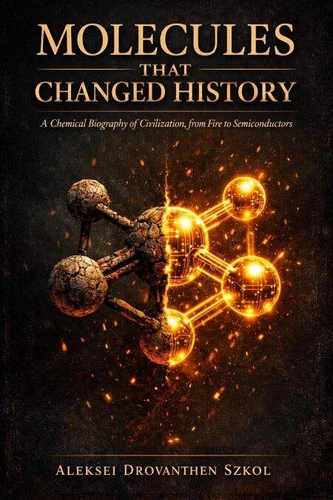
Molecules That Changed History: A Chemical Biography of Civilization, from Fire to Semiconductors
Par :Formats :
Disponible dans votre compte client Decitre ou Furet du Nord dès validation de votre commande. Le format ePub est :
- Compatible avec une lecture sur My Vivlio (smartphone, tablette, ordinateur)
- Compatible avec une lecture sur liseuses Vivlio
- Pour les liseuses autres que Vivlio, vous devez utiliser le logiciel Adobe Digital Edition. Non compatible avec la lecture sur les liseuses Kindle, Remarkable et Sony
 , qui est-ce ?
Notre partenaire de plateforme de lecture numérique où vous retrouverez l'ensemble de vos ebooks gratuitement
Pour en savoir plus sur nos ebooks, consultez notre aide en ligne ici
C'est si simple ! Lisez votre ebook avec l'app Vivlio sur votre tablette, mobile ou ordinateur :

- FormatePub
- ISBN8235122949
- EAN9798235122949
- Date de parution26/06/2026
- Protection num.pas de protection
- Infos supplémentairesepub
- ÉditeurIoakim Ioakim
Résumé
A Royal Air Force pilot lies dying of a wound infection in a North African field hospital in 1943. What saves him is not a bullet removed, but a vial of brownish liquid grown from mold that a careless Scottish bacteriologist almost threw away fifteen years earlier. He recovers in six days. This is the kind of story that history books skip and chemistry books bury under jargon. Molecules That Changed History does neither.
It tells civilization's story through the actual molecules that built it: the controlled fire that rewired the human brain a million years before anyone could explain combustion, the accidental purple dye that launched the entire pharmaceutical industry, the wartime crash program that turned a leaking laboratory flask into the insulation inside every radar set that won the Battle of Britain. Each chapter follows one molecule from obscurity to consequence.
Aspirin and morphine, born from the same German laboratory within days of each other, one becoming the safest drug on earth and the other igniting an addiction crisis that still hasn't ended. Synthetic ammonia, a chemical reaction so unglamorous it has no monument anywhere, yet so consequential that roughly half the nitrogen atoms in your body were pulled out of thin air by an industrial process invented in 1909.
A wild Mexican yam root that, through a chain of chemists, philanthropists, and one Catholic gynecologist convinced he could reconcile birth control with his faith, ended up reshaping marriage, education, and the working lives of women across the world. By the time the story reaches the transistor, the silicon wafer, and the gene editing tool repurposed from a yogurt bacterium's immune system, a pattern becomes impossible to miss: every molecule that has remade the world arrived quietly, was usually discovered by accident, and was almost always recognized by someone who had spent years preparing, without knowing it, to notice exactly that accident.
This is not a textbook and it never pretends to be one. There are no equations to skip past and no dense paragraphs daring you to keep reading. It is built the way the best narrative nonfiction is built, on real people making real decisions under real pressure, with the chemistry explained clearly enough that you will actually remember it at your next dinner party. You will meet the tax collector who reinvented chemistry and lost his head to the guillotine for it.
The eighteen year old who tried to cure malaria and invented an entire industry instead. The wife who could not stop her husband from using the chemistry he loved to gas soldiers in a war. Fourteen chapters carry you from the first fire in a South African cave to the gene editing tool sitting in laboratories right now, deciding the next chapter of this story before it's even written. Every date, every name, every figure is drawn from the historical and scientific record, and where that record is genuinely uncertain, this book says so rather than smoothing it over for a tidier story.
If you have ever wondered how a handful of small, ordinary looking molecules ended up deciding who gets fed, who gets cured, who wins a war, and who gets to plan their own life, this book answers that question one substance at a time, and makes sure you cannot put it down before you find out how the next one ends.
It tells civilization's story through the actual molecules that built it: the controlled fire that rewired the human brain a million years before anyone could explain combustion, the accidental purple dye that launched the entire pharmaceutical industry, the wartime crash program that turned a leaking laboratory flask into the insulation inside every radar set that won the Battle of Britain. Each chapter follows one molecule from obscurity to consequence.
Aspirin and morphine, born from the same German laboratory within days of each other, one becoming the safest drug on earth and the other igniting an addiction crisis that still hasn't ended. Synthetic ammonia, a chemical reaction so unglamorous it has no monument anywhere, yet so consequential that roughly half the nitrogen atoms in your body were pulled out of thin air by an industrial process invented in 1909.
A wild Mexican yam root that, through a chain of chemists, philanthropists, and one Catholic gynecologist convinced he could reconcile birth control with his faith, ended up reshaping marriage, education, and the working lives of women across the world. By the time the story reaches the transistor, the silicon wafer, and the gene editing tool repurposed from a yogurt bacterium's immune system, a pattern becomes impossible to miss: every molecule that has remade the world arrived quietly, was usually discovered by accident, and was almost always recognized by someone who had spent years preparing, without knowing it, to notice exactly that accident.
This is not a textbook and it never pretends to be one. There are no equations to skip past and no dense paragraphs daring you to keep reading. It is built the way the best narrative nonfiction is built, on real people making real decisions under real pressure, with the chemistry explained clearly enough that you will actually remember it at your next dinner party. You will meet the tax collector who reinvented chemistry and lost his head to the guillotine for it.
The eighteen year old who tried to cure malaria and invented an entire industry instead. The wife who could not stop her husband from using the chemistry he loved to gas soldiers in a war. Fourteen chapters carry you from the first fire in a South African cave to the gene editing tool sitting in laboratories right now, deciding the next chapter of this story before it's even written. Every date, every name, every figure is drawn from the historical and scientific record, and where that record is genuinely uncertain, this book says so rather than smoothing it over for a tidier story.
If you have ever wondered how a handful of small, ordinary looking molecules ended up deciding who gets fed, who gets cured, who wins a war, and who gets to plan their own life, this book answers that question one substance at a time, and makes sure you cannot put it down before you find out how the next one ends.