
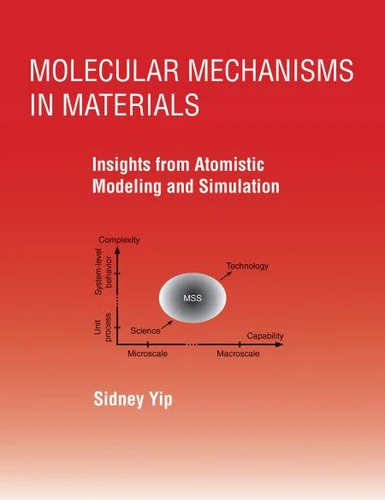
Molecular Mechanisms in Materials. Insights from Atomistic Modeling and Simulation
Par :Formats :
Disponible dans votre compte client Decitre ou Furet du Nord dès validation de votre commande. Le format ePub protégé est :
- Compatible avec une lecture sur My Vivlio (smartphone, tablette, ordinateur)
- Compatible avec une lecture sur liseuses Vivlio
- Pour les liseuses autres que Vivlio, vous devez utiliser le logiciel Adobe Digital Edition. Non compatible avec la lecture sur les liseuses Kindle, Remarkable et Sony
- Non compatible avec un achat hors France métropolitaine
 , qui est-ce ?
Notre partenaire de plateforme de lecture numérique où vous retrouverez l'ensemble de vos ebooks gratuitement
Pour en savoir plus sur nos ebooks, consultez notre aide en ligne ici
C'est si simple ! Lisez votre ebook avec l'app Vivlio sur votre tablette, mobile ou ordinateur :

- Nombre de pages286
- FormatePub
- ISBN978-0-262-37495-8
- EAN9780262374958
- Date de parution24/10/2023
- Protection num.Adobe DRM
- Taille46 Mo
- Infos supplémentairesepub
- ÉditeurThe MIT Press
Résumé
A student-oriented introduction to understanding mechanisms at the atomistic level controlling macroscopic materials phenomena through molecular dynamics simulations. Machine-learning-based computation in materials innovation, performance optimization, and sustainability offers exciting opportunities at the mesoscale research frontier. Molecular Mechanisms in Materials presents research findings and insights about material behavior at the molecular level and its impact on macroscopic properties.
The book's fifteen essays represent author Sidney Yip's work in atomistic modeling and materials simulation over more than five decades. The phenomena are grouped into five basic types: fluctuations in simple fluids, crystal melting, plasticity and fracture, glassy relaxations, and amorphous rheology, all focused on molecular mechanisms in base materials. The organizing principle of Molecular Mechanisms in Materials is multiscale modeling and simulation, where conceptual models and simulation techniques are linked across the micro-to-macro length and time scales to control the outcome of specific materials processes.
Each essay addresses a specific standalone topic of materials phenomena while also recognizing the larger context of materials science and technology. Individual case studies serve both as standalone essays and companion pieces to each other. Indeed, the global transformation of science and technology is well underway: in his epilogue, Yip discusses the potential of artificial intelligence and machine learning to enhance future materials for societal benefits in the face of global challenges such as climate change, energy sustainability, infrastructure renewal, and nuclear arms control.
The book's fifteen essays represent author Sidney Yip's work in atomistic modeling and materials simulation over more than five decades. The phenomena are grouped into five basic types: fluctuations in simple fluids, crystal melting, plasticity and fracture, glassy relaxations, and amorphous rheology, all focused on molecular mechanisms in base materials. The organizing principle of Molecular Mechanisms in Materials is multiscale modeling and simulation, where conceptual models and simulation techniques are linked across the micro-to-macro length and time scales to control the outcome of specific materials processes.
Each essay addresses a specific standalone topic of materials phenomena while also recognizing the larger context of materials science and technology. Individual case studies serve both as standalone essays and companion pieces to each other. Indeed, the global transformation of science and technology is well underway: in his epilogue, Yip discusses the potential of artificial intelligence and machine learning to enhance future materials for societal benefits in the face of global challenges such as climate change, energy sustainability, infrastructure renewal, and nuclear arms control.