SOLDES
Jusqu'à -70% sur une sélection d'articles*

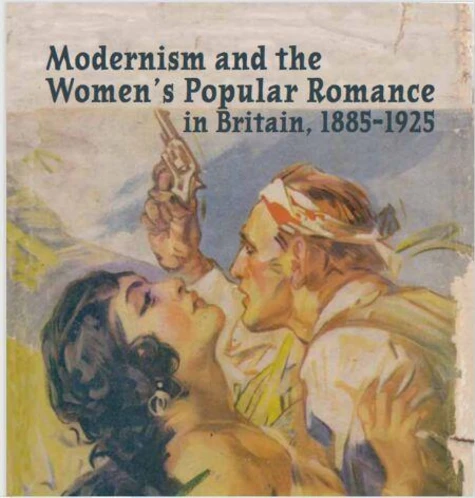
Modernism and the Women's Popular Romance in Britain, 1885-1925
Par :Formats :
Disponible dans votre compte client Decitre ou Furet du Nord dès validation de votre commande. Le format ePub est :
- Compatible avec une lecture sur My Vivlio (smartphone, tablette, ordinateur)
- Compatible avec une lecture sur liseuses Vivlio
- Pour les liseuses autres que Vivlio, vous devez utiliser le logiciel Adobe Digital Edition. Non compatible avec la lecture sur les liseuses Kindle, Remarkable et Sony
 , qui est-ce ?
Notre partenaire de plateforme de lecture numérique où vous retrouverez l'ensemble de vos ebooks gratuitement
Pour en savoir plus sur nos ebooks, consultez notre aide en ligne ici
C'est si simple ! Lisez votre ebook avec l'app Vivlio sur votre tablette, mobile ou ordinateur :

- FormatePub
- ISBN8201488109
- EAN9798201488109
- Date de parution17/04/2022
- Protection num.pas de protection
- Infos supplémentairesepub
- ÉditeurJL
Résumé
The "low modern" and the "popular modernist" are twin classifying categories, emerging in contemporary scholarship on the modernist era, that may help us todeepen our understanding of the most widely read British litera- ture of the late nineteenth and early twentieth centuries. They offer a literary-historical register on which to record the social "pitch" or "range" of the era's distinctive genres of popular fiction, and they bring new tones into our concepts of high modernism.
In recent years, scholarship on the New Woman novel, detective fiction, the adventure romance, and literary experiments of content (as distinct from form)1 has restored such middlebrow and lowbrow genres to their proper centrality in the history of fiction, and narrative generally, through the decades straddling 1900. As recently as the early 1990s, a scholar of British fin-de-siècle-through-1920s fic- tion could decry the "rigid demarcation between highbrow ( James, Conrad, Lawrence, Joyce, Woolf ), middlebrow (Wells, Bennett, Galsworthy, Forster) and lowbrow (names too numerous and repel- lent to mention)" and could observe that "[t]here are scrupulous and imaginative histories available which assess the first group critically, summarize the second sympathetically, and ignore the third."2 Fif- teen years later, the editors of the volume Bad Modernisms noted that some scholars had transformed the term modernist "from an evalua- tive and stylistic designation to a neutral and temporal one" to go "beyond such familiar figures as Eliot, Pound, Joyce and Woolf " and to embrace "less widely known women writers" and "authors of mass cultural fiction."3 Our knowledge of the vast body of popu- lar fiction from this era is, in this sense, being democratized.
In recent years, scholarship on the New Woman novel, detective fiction, the adventure romance, and literary experiments of content (as distinct from form)1 has restored such middlebrow and lowbrow genres to their proper centrality in the history of fiction, and narrative generally, through the decades straddling 1900. As recently as the early 1990s, a scholar of British fin-de-siècle-through-1920s fic- tion could decry the "rigid demarcation between highbrow ( James, Conrad, Lawrence, Joyce, Woolf ), middlebrow (Wells, Bennett, Galsworthy, Forster) and lowbrow (names too numerous and repel- lent to mention)" and could observe that "[t]here are scrupulous and imaginative histories available which assess the first group critically, summarize the second sympathetically, and ignore the third."2 Fif- teen years later, the editors of the volume Bad Modernisms noted that some scholars had transformed the term modernist "from an evalua- tive and stylistic designation to a neutral and temporal one" to go "beyond such familiar figures as Eliot, Pound, Joyce and Woolf " and to embrace "less widely known women writers" and "authors of mass cultural fiction."3 Our knowledge of the vast body of popu- lar fiction from this era is, in this sense, being democratized.