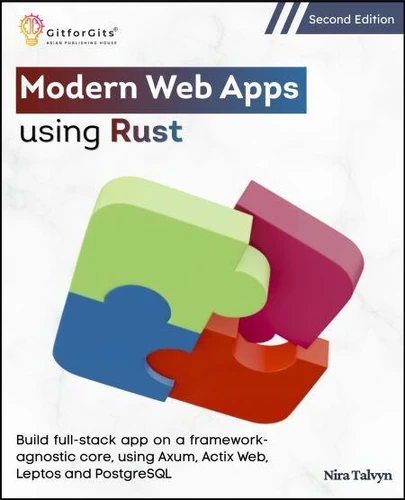
Halfway through this book you build the entire server again, on a different web framework. This book isn't for practice, but to test out the architecture. All you are learning in this book, is build a full-stack Rust application, on Axum, and then rebuild it again on Actix Web 4, and the domain crate won't change at all. Under both, you'll find a pinned Rust 1.95 and edition 2024 toolchain, business rules that don't rely on any framework, and PostgreSQL accessed through SQLx with queries and transactions that are verified at compile time.
When you're done there, you'll have versioned REST APIs and a GraphQL schema, OAuth2 sign-in with GitHub, JWT claims and Argon2 hashing, and a reactive Leptos storefront compiled to WebAssembly. With WebSockets, you can stream live updates, size Tokio runtimes and connection pools by measurement, then ship to Kubernetes through a gated pipeline. The idea is not to turn you into a Rust expert overnight, but to equip you with the knowledge to build something that will keep on going long after its dependencies are obsolete. Key LearningsSeparate business rules into a domain crate depending on no framework, database or runtime.
Build asynchronous web services on Axum with typed state, extractors and tower middleware. Rebuild same server on Actix Web 4 and work with per-worker arbiter model. Query PostgreSQL through SQLx using reversible migrations and transactions. Publish versioned REST APIs and a GraphQL schema with DataLoader batching. Add OAuth2 sign-in with GitHub, JWT claims and Argon2 password hashing. Build reactive Leptos front-end compiled to WebAssembly, with server-side rendering.
Stream live updates over WebSockets, and tune Tokio runtimes and connection pools. Containerize with Docker and cargo-chef, and ship to Kubernetes through CI pipeline. Table of ContentSetting up Rust 2024, Zed and LeptosDesigning Modern ArchitectureBuilding App Server with AxumBuilding Server with Actix WebDatabase Integration and State ManagementModern Interactions with REST, GraphQL and OAuthFront-end Development with Leptos and WebAssemblyReal-time Interactions using WebSocketsModern Security, Performance and TuningCloud-native Releases and Continuous Delivery
Halfway through this book you build the entire server again, on a different web framework. This book isn't for practice, but to test out the architecture. All you are learning in this book, is build a full-stack Rust application, on Axum, and then rebuild it again on Actix Web 4, and the domain crate won't change at all. Under both, you'll find a pinned Rust 1.95 and edition 2024 toolchain, business rules that don't rely on any framework, and PostgreSQL accessed through SQLx with queries and transactions that are verified at compile time.
When you're done there, you'll have versioned REST APIs and a GraphQL schema, OAuth2 sign-in with GitHub, JWT claims and Argon2 hashing, and a reactive Leptos storefront compiled to WebAssembly. With WebSockets, you can stream live updates, size Tokio runtimes and connection pools by measurement, then ship to Kubernetes through a gated pipeline. The idea is not to turn you into a Rust expert overnight, but to equip you with the knowledge to build something that will keep on going long after its dependencies are obsolete. Key LearningsSeparate business rules into a domain crate depending on no framework, database or runtime.
Build asynchronous web services on Axum with typed state, extractors and tower middleware. Rebuild same server on Actix Web 4 and work with per-worker arbiter model. Query PostgreSQL through SQLx using reversible migrations and transactions. Publish versioned REST APIs and a GraphQL schema with DataLoader batching. Add OAuth2 sign-in with GitHub, JWT claims and Argon2 password hashing. Build reactive Leptos front-end compiled to WebAssembly, with server-side rendering.
Stream live updates over WebSockets, and tune Tokio runtimes and connection pools. Containerize with Docker and cargo-chef, and ship to Kubernetes through CI pipeline. Table of ContentSetting up Rust 2024, Zed and LeptosDesigning Modern ArchitectureBuilding App Server with AxumBuilding Server with Actix WebDatabase Integration and State ManagementModern Interactions with REST, GraphQL and OAuthFront-end Development with Leptos and WebAssemblyReal-time Interactions using WebSocketsModern Security, Performance and TuningCloud-native Releases and Continuous Delivery


 , qui est-ce ?
