OFFRE LISEUSES
Une liseuse achetée = une housse offerte* jusqu'au 21 juin

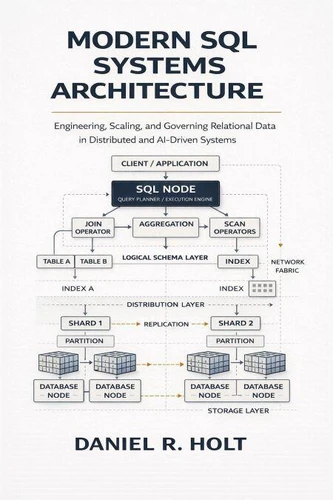
Modern SQL Systems Architecture: Engineering, Scaling, and Governing Relational Data in Distributed and AI-Driven Systems
Par :Formats :
Disponible dans votre compte client Decitre ou Furet du Nord dès validation de votre commande. Le format ePub est :
- Compatible avec une lecture sur My Vivlio (smartphone, tablette, ordinateur)
- Compatible avec une lecture sur liseuses Vivlio
- Pour les liseuses autres que Vivlio, vous devez utiliser le logiciel Adobe Digital Edition. Non compatible avec la lecture sur les liseuses Kindle, Remarkable et Sony
 , qui est-ce ?
Notre partenaire de plateforme de lecture numérique où vous retrouverez l'ensemble de vos ebooks gratuitement
Pour en savoir plus sur nos ebooks, consultez notre aide en ligne ici
C'est si simple ! Lisez votre ebook avec l'app Vivlio sur votre tablette, mobile ou ordinateur :

- FormatePub
- ISBN8233198779
- EAN9798233198779
- Date de parution22/02/2026
- Protection num.pas de protection
- Infos supplémentairesepub
- ÉditeurLinda Balsamo
Résumé
Modern SQL Systems ArchitectureEngineering, Scaling, and Governing Relational Data in Distributed and AI-Driven SystemsBy Daniel R. HoltRelational databases remain the structural backbone of modern software systems. Yet at scale, SQL is no longer just a query language - it is infrastructure. Modern SQL Systems Architecture is a systems-level exploration of how relational engines behave under real production pressure.
Rather than teaching syntax or vendor-specific configuration, this book examines the mechanics that govern performance, correctness, scalability, resilience, and cost in distributed and cloud-native environments. Across eighteen deeply structured chapters, Daniel R. Holt connects internal engine behavior to architectural consequences. Topics include cost-based optimization, concurrency control, write-ahead logging, MVCC internals, replication realities, partitioning strategies, index amplification, schema evolution without downtime, and production observability.
The book also addresses cloud warehouse economics, AI-generated SQL workloads, governance guardrails, and executive-level trade-offs such as build-versus-buy decisions and vendor lock-in risk. Through detailed failure case studies, readers see how seemingly minor design choices can cascade into replication lag, write collapse, partition imbalance, or cost explosions. Each discussion focuses on structural reasoning rather than isolated tuning techniques, helping practitioners develop durable mental models that apply across database engines and platforms.
Who This Book Is ForThis book is written for senior software engineers, database engineers, data platform architects, site reliability engineers, and technical leaders responsible for operating relational systems in production. It assumes familiarity with SQL fundamentals and concentrates on architectural depth rather than introductory material. What This Book Is NotThis is not a beginner's SQL guide.
It does not teach basic queries, provide certification preparation, or focus on a single database product. It is not a collection of quick performance tricks. Instead, it is a reference-class work designed to strengthen architectural judgment and operational clarity. Relational systems endure because they encode discipline. This book equips you to operate them with the same discipline - at scale, under pressure, and in modern distributed environments.
Rather than teaching syntax or vendor-specific configuration, this book examines the mechanics that govern performance, correctness, scalability, resilience, and cost in distributed and cloud-native environments. Across eighteen deeply structured chapters, Daniel R. Holt connects internal engine behavior to architectural consequences. Topics include cost-based optimization, concurrency control, write-ahead logging, MVCC internals, replication realities, partitioning strategies, index amplification, schema evolution without downtime, and production observability.
The book also addresses cloud warehouse economics, AI-generated SQL workloads, governance guardrails, and executive-level trade-offs such as build-versus-buy decisions and vendor lock-in risk. Through detailed failure case studies, readers see how seemingly minor design choices can cascade into replication lag, write collapse, partition imbalance, or cost explosions. Each discussion focuses on structural reasoning rather than isolated tuning techniques, helping practitioners develop durable mental models that apply across database engines and platforms.
Who This Book Is ForThis book is written for senior software engineers, database engineers, data platform architects, site reliability engineers, and technical leaders responsible for operating relational systems in production. It assumes familiarity with SQL fundamentals and concentrates on architectural depth rather than introductory material. What This Book Is NotThis is not a beginner's SQL guide.
It does not teach basic queries, provide certification preparation, or focus on a single database product. It is not a collection of quick performance tricks. Instead, it is a reference-class work designed to strengthen architectural judgment and operational clarity. Relational systems endure because they encode discipline. This book equips you to operate them with the same discipline - at scale, under pressure, and in modern distributed environments.