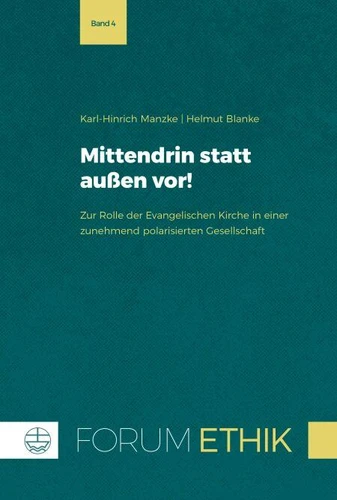
Mittendrin statt außen vor!. Zur Rolle der Evangelischen Kirche in einer zunehmend polarisierten Gesellschaft
Par : ,Formats :
Disponible dans votre compte client Decitre ou Furet du Nord dès validation de votre commande. Le format PDF est :
- Compatible avec une lecture sur My Vivlio (smartphone, tablette, ordinateur)
- Compatible avec une lecture sur liseuses Vivlio
- Pour les liseuses autres que Vivlio, vous devez utiliser le logiciel Adobe Digital Edition. Non compatible avec la lecture sur les liseuses Kindle, Remarkable et Sony
 , qui est-ce ?
Notre partenaire de plateforme de lecture numérique où vous retrouverez l'ensemble de vos ebooks gratuitement
Pour en savoir plus sur nos ebooks, consultez notre aide en ligne ici
C'est si simple ! Lisez votre ebook avec l'app Vivlio sur votre tablette, mobile ou ordinateur :

- Nombre de pages126
- FormatPDF
- ISBN978-3-374-08071-7
- EAN9783374080717
- Date de parution24/04/2026
- Protection num.Digital Watermarking
- Taille4 Mo
- Infos supplémentairespdf
- ÉditeurEvangelische Verlagsanstalt
Résumé
Die öffentliche Rolle der Kirche muss neu gedacht werden! Ausgehend von der aktuellen Diskussion um die sogenannte Öffentliche Theologie hinterfragen die Autoren das traditionelle Bild der Kirche als Wächterin über Moral, Menschenwürde und Barmherzigkeit. Dieses Verständnis ist nicht geeignet, die Rolle der Kirche im modernen Verfassungsstaat angemessen zu beschreiben. Statt für eine Kirche als Moralagentur wird für einen öffentlichen Protestantismus plädiert, der konstruktive, sachbezogene und kontroverse gesellschaftliche Debatten unterstützt, das Gemeinwohl aktiv fördert und das Vertrauen in die Institutionen des modernen Verfassungsstaates als deren Partnerin stärkt.
[Right in the middle instead of on the sidelines! On the role of the Protestant Church in an increasingly polarised society]
The public role of the church needs to be rethought! Based on the current discussion about so-called public theology, the authors question the traditional image of the church as the guardian of morality, human dignity and mercy.
This understanding is not suitable for adequately describing the role of the church in the modern constitutional state. Instead of a church as a moral agency, the authors advocate a public Protestantism that supports constructive, factual and controversial social debates, actively promotes the common good and strengthens trust in the institutions of the modern constitutional state as their partner.
This understanding is not suitable for adequately describing the role of the church in the modern constitutional state. Instead of a church as a moral agency, the authors advocate a public Protestantism that supports constructive, factual and controversial social debates, actively promotes the common good and strengthens trust in the institutions of the modern constitutional state as their partner.