SOLDES
Jusqu'à -70% sur une sélection d'articles*

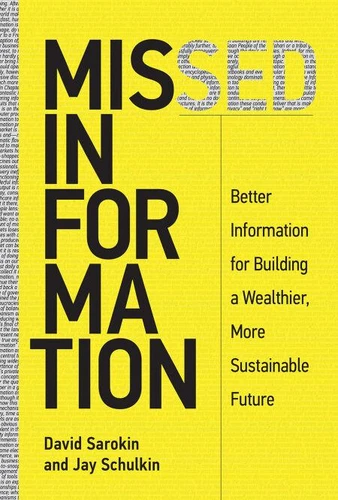
Missed Information. Better Information for Building a Wealthier, More Sustainable Future
Par : ,Formats :
Disponible dans votre compte client Decitre ou Furet du Nord dès validation de votre commande. Le format ePub protégé est :
- Compatible avec une lecture sur My Vivlio (smartphone, tablette, ordinateur)
- Compatible avec une lecture sur liseuses Vivlio
- Pour les liseuses autres que Vivlio, vous devez utiliser le logiciel Adobe Digital Edition. Non compatible avec la lecture sur les liseuses Kindle, Remarkable et Sony
- Non compatible avec un achat hors France métropolitaine
 , qui est-ce ?
Notre partenaire de plateforme de lecture numérique où vous retrouverez l'ensemble de vos ebooks gratuitement
Pour en savoir plus sur nos ebooks, consultez notre aide en ligne ici
C'est si simple ! Lisez votre ebook avec l'app Vivlio sur votre tablette, mobile ou ordinateur :

- Nombre de pages264
- FormatePub
- ISBN978-0-262-33626-0
- EAN9780262336260
- Date de parution19/08/2016
- Protection num.Adobe DRM
- Taille4 Mo
- Infos supplémentairesepub
- ÉditeurThe MIT Press
Résumé
How better information and better access to it improves the quality of our decisions and makes for a more vibrant participatory society. Information is power. It drives commerce, protects nations, and forms the backbone of systems that range from health care to high finance. Yet despite the avalanche of data available in today's information age, neither institutions nor individuals get the information they truly need to make well-informed decisions.
Faulty information and sub-optimal decision-making create an imbalance of power that is exaggerated as governments and corporations amass enormous databases on each of us. Who has more power: the government, in possession of uncounted terabytes of data (some of it obtained by cybersnooping), or the ordinary citizen, trying to get in touch with a government agency? In Missed Information, David Sarokin and Jay Schulkin explore information-not information technology, but information itself-as a central part of our lives and institutions.
They show that providing better information and better access to it improves the quality of our decisions and makes for a more vibrant participatory society. Sarokin and Schulkin argue that freely flowing information helps systems run more efficiently and that incomplete information does just the opposite. It's easier to comparison shop for microwave ovens than for doctors or hospitals because of information gaps that hinder the entire health-care system.
Better information about such social ills as child labor and pollution can help consumers support more sustainable products. The authors examine the opacity of corporate annual reports, the impenetrability of government secrets, and emerging techniques of "information foraging." The information imbalance of power can be reconfigured, they argue, with greater and more meaningful transparency from government and corporations.
Faulty information and sub-optimal decision-making create an imbalance of power that is exaggerated as governments and corporations amass enormous databases on each of us. Who has more power: the government, in possession of uncounted terabytes of data (some of it obtained by cybersnooping), or the ordinary citizen, trying to get in touch with a government agency? In Missed Information, David Sarokin and Jay Schulkin explore information-not information technology, but information itself-as a central part of our lives and institutions.
They show that providing better information and better access to it improves the quality of our decisions and makes for a more vibrant participatory society. Sarokin and Schulkin argue that freely flowing information helps systems run more efficiently and that incomplete information does just the opposite. It's easier to comparison shop for microwave ovens than for doctors or hospitals because of information gaps that hinder the entire health-care system.
Better information about such social ills as child labor and pollution can help consumers support more sustainable products. The authors examine the opacity of corporate annual reports, the impenetrability of government secrets, and emerging techniques of "information foraging." The information imbalance of power can be reconfigured, they argue, with greater and more meaningful transparency from government and corporations.