
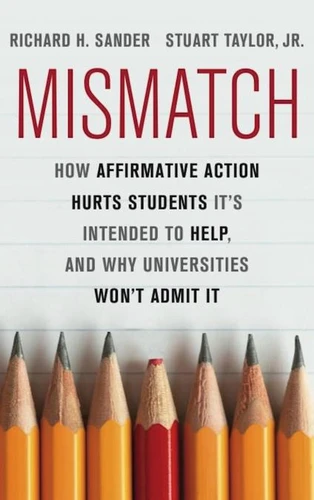
Mismatch. How Affirmative Action Hurts Students It's Intended to Help, and Why Universities Won't Admit It
Par : ,Formats :
Disponible dans votre compte client Decitre ou Furet du Nord dès validation de votre commande. Le format ePub protégé est :
- Compatible avec une lecture sur My Vivlio (smartphone, tablette, ordinateur)
- Compatible avec une lecture sur liseuses Vivlio
- Pour les liseuses autres que Vivlio, vous devez utiliser le logiciel Adobe Digital Edition. Non compatible avec la lecture sur les liseuses Kindle, Remarkable et Sony
- Non compatible avec un achat hors France métropolitaine
 , qui est-ce ?
Notre partenaire de plateforme de lecture numérique où vous retrouverez l'ensemble de vos ebooks gratuitement
Pour en savoir plus sur nos ebooks, consultez notre aide en ligne ici
C'est si simple ! Lisez votre ebook avec l'app Vivlio sur votre tablette, mobile ou ordinateur :

- Nombre de pages368
- FormatePub
- ISBN978-0-465-03001-9
- EAN9780465030019
- Date de parution08/10/2012
- Protection num.Adobe DRM
- Infos supplémentairesepub
- ÉditeurBasic Books
Résumé
The debate over affirmative action has raged for over four decades, with little give on either side. Most agree that it began as noble effort to jump-start racial integration; many believe it devolved into a patently unfair system of quotas and concealment. Now, with the Supreme Court set to rule on a case that could sharply curtail the use of racial preferences in American universities, law professor Richard Sander and legal journalist Stuart Taylor offer a definitive account of what affirmative action has become, showing that while the objective is laudable, the effects have been anything but.
Sander and Taylor have long admired affirmative action's original goals, but after many years of studying racial preferences, they have reached a controversial but undeniable conclusion: that preferences hurt underrepresented minorities far more than they help them. At the heart of affirmative action's failure is a simple phenomenon called mismatch. Using dramatic new data and numerous interviews with affected former students and university officials of color, the authors show how racial preferences often put students in competition with far better-prepared classmates, dooming many to fall so far behind that they can never catch up.
Mismatch largely explains why, even though black applicants are more likely to enter college than whites with similar backgrounds, they are far less likely to finish; why there are so few black and Hispanic professionals with science and engineering degrees and doctorates; why black law graduates fail bar exams at four times the rate of whites; and why universities accept relatively affluent minorities over working class and poor people of all races.
Sander and Taylor believe it is possible to achieve the goal of racial equality in higher education, but they argue that alternative policies -- such as full public disclosure of all preferential admission policies, a focused commitment to improving socioeconomic diversity on campuses, outreach to minority communities, and a renewed focus on K-12 schooling -- will go farther in achieving that goal than preferences, while also allowing applicants to make informed decisions.
Bold, controversial, and deeply researched, Mismatch calls for a renewed examination of this most divisive of social programs -- and for reforms that will help realize the ultimate goal of racial equality.
Sander and Taylor have long admired affirmative action's original goals, but after many years of studying racial preferences, they have reached a controversial but undeniable conclusion: that preferences hurt underrepresented minorities far more than they help them. At the heart of affirmative action's failure is a simple phenomenon called mismatch. Using dramatic new data and numerous interviews with affected former students and university officials of color, the authors show how racial preferences often put students in competition with far better-prepared classmates, dooming many to fall so far behind that they can never catch up.
Mismatch largely explains why, even though black applicants are more likely to enter college than whites with similar backgrounds, they are far less likely to finish; why there are so few black and Hispanic professionals with science and engineering degrees and doctorates; why black law graduates fail bar exams at four times the rate of whites; and why universities accept relatively affluent minorities over working class and poor people of all races.
Sander and Taylor believe it is possible to achieve the goal of racial equality in higher education, but they argue that alternative policies -- such as full public disclosure of all preferential admission policies, a focused commitment to improving socioeconomic diversity on campuses, outreach to minority communities, and a renewed focus on K-12 schooling -- will go farther in achieving that goal than preferences, while also allowing applicants to make informed decisions.
Bold, controversial, and deeply researched, Mismatch calls for a renewed examination of this most divisive of social programs -- and for reforms that will help realize the ultimate goal of racial equality.