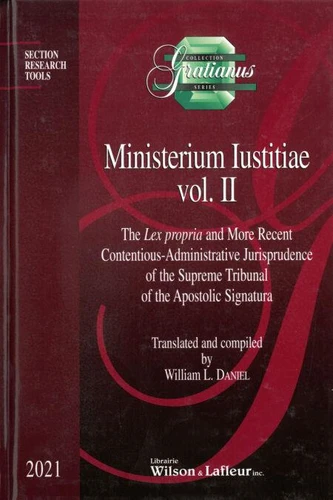
Ministerium Iustitiae, Vol. II : The Lex propria and More Recent Contentious-Administrative Jurisprudence of the Supreme Tribunal of the Apostolic Signatura
Par :Formats :
Disponible dans votre compte client Decitre ou Furet du Nord dès validation de votre commande. Le format PDF protégé est :
- Compatible avec une lecture sur My Vivlio (smartphone, tablette, ordinateur)
- Compatible avec une lecture sur liseuses Vivlio
- Pour les liseuses autres que Vivlio, vous devez utiliser le logiciel Adobe Digital Edition. Non compatible avec la lecture sur les liseuses Kindle, Remarkable et Sony
- Non compatible avec un achat hors France métropolitaine
 , qui est-ce ?
Notre partenaire de plateforme de lecture numérique où vous retrouverez l'ensemble de vos ebooks gratuitement
Pour en savoir plus sur nos ebooks, consultez notre aide en ligne ici
C'est si simple ! Lisez votre ebook avec l'app Vivlio sur votre tablette, mobile ou ordinateur :

- Nombre de pages782
- FormatPDF
- ISBN978-2-924974-26-1
- EAN9782924974261
- Date de parution25/06/2026
- Protection num.Adobe DRM
- Taille4 Mo
- Infos supplémentairespdf
- ÉditeurWilson & Lafleur
Résumé
The year 2017 marked the fiftieth anniversary of Pope St. Paul VI's institution of the Supreme Tribunal of the Apostolic Signatura's Sectio altera. This brought to a certain fulfillment the Church's aspiration that members of the faithful aggrieved by administrative authorities enjoy the right to defend themselves against the unjust exercise of the power of governance. This foundational normative provision has promoted and continues to promote good governance at all levels the Church, in different ways.
It is therefore worthy of recognition by dedicating a whole volume of the Apostolic Signatura's jurisprudence to contentious-administrative causes. This has been made possible because of the Dicastery's efforts, over the last fifteen or twenty years, to promote knowledge of this jurisprudence, especially by widely authorizing its publication. One beholds in these pages a superior example of technical precision and judicial restraint.
For the Second Section of the Supreme Tribunal displays for the Church the model of the just judge in the ecclesial society. It demonstrates how it is not for the judge to innovate but to interpret and apply the law. It is not for the judge to show mercy to one party while violating the other's rights, but to give to each what is his due. This norm of justice in the Second Section's activity is based on the dignity and necessity of the administrative function, which is carried out largely by those with the care of souls.
Local authorities are in the position of wisely and benevolently attending to the souls in their care, but they must do so in accord with the sacred discipline of the Church. When they do not, and when this defect is prolonged or even exacerbated by a dicastery of the Roman Curia, the last recourse is to be made to this just judge, the Second Section, which neither encroaches upon the public administration nor dispenses it from the norm of law, and which neither favors the individual member of the faithful nor ignores his pleas for justice against an ecclesiastical authority of any dignity below the Supreme Pontiff.
It is therefore worthy of recognition by dedicating a whole volume of the Apostolic Signatura's jurisprudence to contentious-administrative causes. This has been made possible because of the Dicastery's efforts, over the last fifteen or twenty years, to promote knowledge of this jurisprudence, especially by widely authorizing its publication. One beholds in these pages a superior example of technical precision and judicial restraint.
For the Second Section of the Supreme Tribunal displays for the Church the model of the just judge in the ecclesial society. It demonstrates how it is not for the judge to innovate but to interpret and apply the law. It is not for the judge to show mercy to one party while violating the other's rights, but to give to each what is his due. This norm of justice in the Second Section's activity is based on the dignity and necessity of the administrative function, which is carried out largely by those with the care of souls.
Local authorities are in the position of wisely and benevolently attending to the souls in their care, but they must do so in accord with the sacred discipline of the Church. When they do not, and when this defect is prolonged or even exacerbated by a dicastery of the Roman Curia, the last recourse is to be made to this just judge, the Second Section, which neither encroaches upon the public administration nor dispenses it from the norm of law, and which neither favors the individual member of the faithful nor ignores his pleas for justice against an ecclesiastical authority of any dignity below the Supreme Pontiff.