
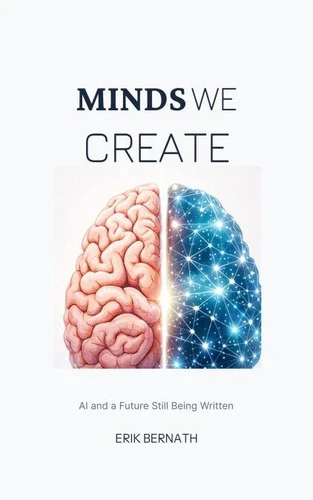
Minds We Create: AI and a Future Still Being Written
Par :Formats :
Disponible dans votre compte client Decitre ou Furet du Nord dès validation de votre commande. Le format ePub est :
- Compatible avec une lecture sur My Vivlio (smartphone, tablette, ordinateur)
- Compatible avec une lecture sur liseuses Vivlio
- Pour les liseuses autres que Vivlio, vous devez utiliser le logiciel Adobe Digital Edition. Non compatible avec la lecture sur les liseuses Kindle, Remarkable et Sony
 , qui est-ce ?
Notre partenaire de plateforme de lecture numérique où vous retrouverez l'ensemble de vos ebooks gratuitement
Pour en savoir plus sur nos ebooks, consultez notre aide en ligne ici
C'est si simple ! Lisez votre ebook avec l'app Vivlio sur votre tablette, mobile ou ordinateur :

- FormatePub
- ISBN978-615-82993-2-9
- EAN9786158299329
- Date de parution05/04/2026
- Protection num.pas de protection
- Infos supplémentairesepub
- ÉditeurErik Bernath
Résumé
Something large is happening. Most people can feel it. Very few have a clear framework for thinking about it. Minds We Create: AI and a Future Still Being Written is for the second group - readers who want to understand artificial intelligence not through hype or panic, but through the lens of how complex technologies have succeeded and failed before, what the actual problems are, and what functioning responses to those problems look like.
This is not a technical manual. It does not assume you know how a neural network works or have followed the AI policy debates. It assumes only that you are paying attention and want to think clearly. The book opens with humans in crisis, not algorithms. A Soviet submarine officer who prevented a nuclear war because the decision structure gave his judgment the weight it needed. A pharmacologist at the FDA who kept asking where the safety evidence was - until her persistence kept a generation of American children safe from thalidomide.
A NASA engineer who thought systematically about what could go wrong before Challenger launched, and the organizational failure that meant no one listened. These are not decorative analogies. They are the intellectual tools required to understand AI safety - because AI safety is not primarily a computer science problem. It is a problem about institutional pressure, competitive dynamics, and whether the careful judgment gets the weight it needs when it matters most.
Across twenty-one chapters, the book works through the full landscape: how large language models actually work and why their capabilities emerge without warning; the alignment problem and what it means to build a system that does what you actually want; why interpretability is a precondition for everything else; how adversarial attacks reveal what safety testing misses; the economics of automation and concentrated power; AI consciousness and why the question cannot be dismissed; and governance - what functioning collective oversight looks like, what the current frameworks lack, and what needs to be built.
The final chapters address the present moment directly. The book was completed in February 2026, as a real-time standoff between the US Department of Defense and an AI company over autonomous weapons and mass surveillance was unfolding. The analysis in the preceding chapters was written before that standoff. It explains it anyway. The situation is genuinely open. What happens next depends, in no small part, on what people who understand it are willing to do.
You have started by reading. That is not nothing.
This is not a technical manual. It does not assume you know how a neural network works or have followed the AI policy debates. It assumes only that you are paying attention and want to think clearly. The book opens with humans in crisis, not algorithms. A Soviet submarine officer who prevented a nuclear war because the decision structure gave his judgment the weight it needed. A pharmacologist at the FDA who kept asking where the safety evidence was - until her persistence kept a generation of American children safe from thalidomide.
A NASA engineer who thought systematically about what could go wrong before Challenger launched, and the organizational failure that meant no one listened. These are not decorative analogies. They are the intellectual tools required to understand AI safety - because AI safety is not primarily a computer science problem. It is a problem about institutional pressure, competitive dynamics, and whether the careful judgment gets the weight it needs when it matters most.
Across twenty-one chapters, the book works through the full landscape: how large language models actually work and why their capabilities emerge without warning; the alignment problem and what it means to build a system that does what you actually want; why interpretability is a precondition for everything else; how adversarial attacks reveal what safety testing misses; the economics of automation and concentrated power; AI consciousness and why the question cannot be dismissed; and governance - what functioning collective oversight looks like, what the current frameworks lack, and what needs to be built.
The final chapters address the present moment directly. The book was completed in February 2026, as a real-time standoff between the US Department of Defense and an AI company over autonomous weapons and mass surveillance was unfolding. The analysis in the preceding chapters was written before that standoff. It explains it anyway. The situation is genuinely open. What happens next depends, in no small part, on what people who understand it are willing to do.
You have started by reading. That is not nothing.