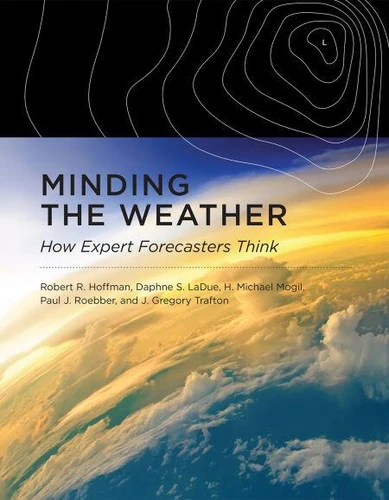
Minding the Weather. How Expert Forecasters Think
Par : , , , ,Formats :
Disponible dans votre compte client Decitre ou Furet du Nord dès validation de votre commande. Le format ePub protégé est :
- Compatible avec une lecture sur My Vivlio (smartphone, tablette, ordinateur)
- Compatible avec une lecture sur liseuses Vivlio
- Pour les liseuses autres que Vivlio, vous devez utiliser le logiciel Adobe Digital Edition. Non compatible avec la lecture sur les liseuses Kindle, Remarkable et Sony
- Non compatible avec un achat hors France métropolitaine
 , qui est-ce ?
Notre partenaire de plateforme de lecture numérique où vous retrouverez l'ensemble de vos ebooks gratuitement
Pour en savoir plus sur nos ebooks, consultez notre aide en ligne ici
C'est si simple ! Lisez votre ebook avec l'app Vivlio sur votre tablette, mobile ou ordinateur :

- Nombre de pages488
- FormatePub
- ISBN978-0-262-33941-4
- EAN9780262339414
- Date de parution11/08/2017
- Protection num.Adobe DRM
- Taille18 Mo
- Infos supplémentairesepub
- ÉditeurThe MIT Press
Résumé
A detailed study of research on the psychology of expertise in weather forecasting, drawing on findings in cognitive science, meteorology, and computer science. This book argues that the human cognition system is the least understood, yet probably most important, component of forecasting accuracy. Minding the Weather investigates how people acquire massive and highly organized knowledge and develop the reasoning skills and strategies that enable them to achieve the highest levels of performance.
The authors consider such topics as the forecasting workplace; atmospheric scientists' descriptions of their reasoning strategies; the nature of expertise; forecaster knowledge, perceptual skills, and reasoning; and expert systems designed to imitate forecaster reasoning. Drawing on research in cognitive science, meteorology, and computer science, the authors argue that forecasting involves an interdependence of humans and technologies.
Human expertise will always be necessary.
The authors consider such topics as the forecasting workplace; atmospheric scientists' descriptions of their reasoning strategies; the nature of expertise; forecaster knowledge, perceptual skills, and reasoning; and expert systems designed to imitate forecaster reasoning. Drawing on research in cognitive science, meteorology, and computer science, the authors argue that forecasting involves an interdependence of humans and technologies.
Human expertise will always be necessary.