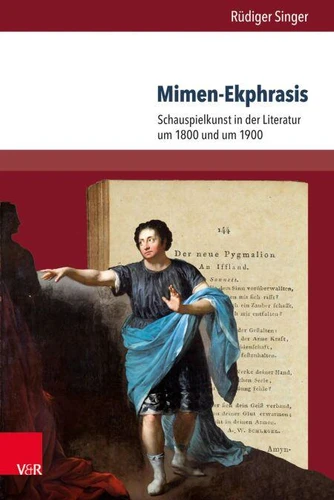
»Dem Mimen flicht die Nachwelt keine Kränze« : Im Widerspruch zu Schillers Behauptung entstanden seit dem 18. Jahrhundert zahlreiche Vers- und Prosatexte mit dem Anspruch, die »Kunst« großer Mimen zu vergegenwärtigen. Der Begriff »Mimen-Ekphrasis« stellt die Gattung einerseits in die rhetorische Tradition lebendiger >Beschreibungskunst<; andererseits wird sie als Sonderform von >Kunstbeschreibung< im Zeichen der Diskussion von Wort-Bild-Beziehungen im 18.
Jahrhundert interpretiert. Rhetorik, Intermedialitätsforschung und Theaterwissenschaft verbindend zeigt Rüdiger Singer, wie unter anderem Diderot, Fielding, Churchill, Lichtenberg, Schink, Böttiger, Goethe, W. v. Humboldt, Tieck, A. W. Schlegel, Hofmannsthal, Bahr, Rilke und D'Annunzio versuchten, ein »Bild« der Kunst von Schauspielern wie Burbage, Garrick, Iffland, Talma, Hendel-Schütz, Kainz und der Duse zu überliefern.
"Posterity weaves no garlands to the mime": This lament by Friedrich Schiller has been contradicted since the 18th century by a largely neglected body of texts striving to re-enact the "art" of great actors in the reader's imagination.
Labelled as "mime-ekphrasis", these texts are situated both in the antique tradition of "vivid descriptions" and in the 18th century tradition of "descriptions of art" marked by a growing fascination with the intricate relations between the "Sister Arts" of poetry and painting. This study bridges intermedial, performance and visual culture studies to reveal how the scenic structure of ekphrasis interacts with the plurimedial character of acting, in English, German, and Italian ekphrases on Burbage, Garrick, Iffland, Talma, Kainz, Duse, et al.
»Dem Mimen flicht die Nachwelt keine Kränze« : Im Widerspruch zu Schillers Behauptung entstanden seit dem 18. Jahrhundert zahlreiche Vers- und Prosatexte mit dem Anspruch, die »Kunst« großer Mimen zu vergegenwärtigen. Der Begriff »Mimen-Ekphrasis« stellt die Gattung einerseits in die rhetorische Tradition lebendiger >Beschreibungskunst<; andererseits wird sie als Sonderform von >Kunstbeschreibung< im Zeichen der Diskussion von Wort-Bild-Beziehungen im 18.
Jahrhundert interpretiert. Rhetorik, Intermedialitätsforschung und Theaterwissenschaft verbindend zeigt Rüdiger Singer, wie unter anderem Diderot, Fielding, Churchill, Lichtenberg, Schink, Böttiger, Goethe, W. v. Humboldt, Tieck, A. W. Schlegel, Hofmannsthal, Bahr, Rilke und D'Annunzio versuchten, ein »Bild« der Kunst von Schauspielern wie Burbage, Garrick, Iffland, Talma, Hendel-Schütz, Kainz und der Duse zu überliefern.
"Posterity weaves no garlands to the mime": This lament by Friedrich Schiller has been contradicted since the 18th century by a largely neglected body of texts striving to re-enact the "art" of great actors in the reader's imagination.
Labelled as "mime-ekphrasis", these texts are situated both in the antique tradition of "vivid descriptions" and in the 18th century tradition of "descriptions of art" marked by a growing fascination with the intricate relations between the "Sister Arts" of poetry and painting. This study bridges intermedial, performance and visual culture studies to reveal how the scenic structure of ekphrasis interacts with the plurimedial character of acting, in English, German, and Italian ekphrases on Burbage, Garrick, Iffland, Talma, Kainz, Duse, et al.