
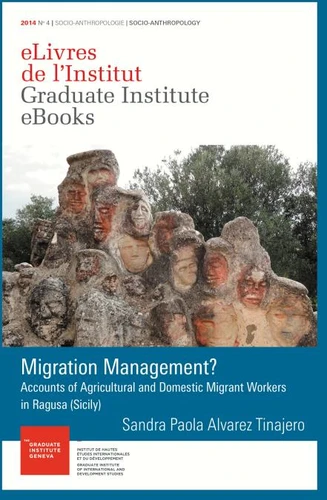
Migration Management?. Accounts of agricultural and domestic migrant workers in Ragusa (Sicily)
Par :Formats :
Disponible dans votre compte client Decitre ou Furet du Nord dès validation de votre commande. Le format Multi-format est :
- Pour les liseuses autres que Vivlio, vous devez utiliser le logiciel Adobe Digital Edition. Non compatible avec la lecture sur les liseuses Kindle, Remarkable et Sony
 , qui est-ce ?
Notre partenaire de plateforme de lecture numérique où vous retrouverez l'ensemble de vos ebooks gratuitement
Pour en savoir plus sur nos ebooks, consultez notre aide en ligne ici
C'est si simple ! Lisez votre ebook avec l'app Vivlio sur votre tablette, mobile ou ordinateur :

- FormatMulti-format
- ISBN978-2-940503-54-4
- EAN9782940503544
- Date de parution26/06/2014
- Protection num.pas de protection
- Infos supplémentairesMulti-Format
- ÉditeurGraduate Institute Publications
Résumé
This book takes the reader into the lives of migrant workers who perform low-status occupations in Ragusa, Sicily. By drawing parallels between the experiences of live-in care and farm migrant workers, the author reveals remarkable similarities in how they relate to the labour market, to the state, and to the employers, building bridges between two sectors of the economy often studied separately. Through extensive fieldwork and interviews with workers and employers, the author explores how structural processes affect, and at the same time enable these actors to act upon them.
First, she situates the mobility of low-status workers within larger economic, social and political processes that have reconfigured local areas assimilating them into the global economy and into specific migration systems. She offers insights into the discourse and practices of migrant workers and employers, revealing the importance of the human dimension of migration, an aspect often neglected in the market-based 'migration management' discourse.
The author reveals how this human dimension touches upon every aspect of the migration experience from recruitment, to policy implementation, to the mutual construction of the identities of employers and workers, which are inevitably negotiated in the intimacy of the home-workplace.
First, she situates the mobility of low-status workers within larger economic, social and political processes that have reconfigured local areas assimilating them into the global economy and into specific migration systems. She offers insights into the discourse and practices of migrant workers and employers, revealing the importance of the human dimension of migration, an aspect often neglected in the market-based 'migration management' discourse.
The author reveals how this human dimension touches upon every aspect of the migration experience from recruitment, to policy implementation, to the mutual construction of the identities of employers and workers, which are inevitably negotiated in the intimacy of the home-workplace.