
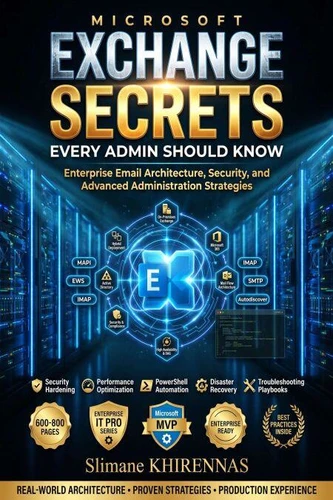
Microsoft Exchange Secrets Every Admin Should Know
Par :Formats :
Disponible dans votre compte client Decitre ou Furet du Nord dès validation de votre commande. Le format ePub est :
- Compatible avec une lecture sur My Vivlio (smartphone, tablette, ordinateur)
- Compatible avec une lecture sur liseuses Vivlio
- Pour les liseuses autres que Vivlio, vous devez utiliser le logiciel Adobe Digital Edition. Non compatible avec la lecture sur les liseuses Kindle, Remarkable et Sony
 , qui est-ce ?
Notre partenaire de plateforme de lecture numérique où vous retrouverez l'ensemble de vos ebooks gratuitement
Pour en savoir plus sur nos ebooks, consultez notre aide en ligne ici
C'est si simple ! Lisez votre ebook avec l'app Vivlio sur votre tablette, mobile ou ordinateur :

- FormatePub
- ISBN8235933798
- EAN9798235933798
- Date de parution26/05/2026
- Protection num.pas de protection
- Infos supplémentairesepub
- ÉditeurIoakim Ioakim
Résumé
This advanced technical manual delivers a deep, enterprise-grade exploration of Microsoft Exchange Server architecture, designed for system administrators, infrastructure engineers, and messaging architects operating in large-scale environments. It presents a comprehensive breakdown of Exchange ecosystem internals, including on-premises, hybrid, and cloud-integrated deployments with Microsoft 365.
The book examines core components such as Active Directory integration, transport pipeline behavior, mailbox database architecture, and client connectivity mechanisms including Outlook MAPI, EWS, SMTP, IMAP, and Autodiscover. It provides a detailed analysis of how messages traverse enterprise mail flow systems, how routing decisions are made, and how transport services interact within distributed infrastructures.
A major focus is placed on high availability design patterns using Database Availability Groups (DAG), including replication logic, failover scenarios, and disaster recovery engineering. The book further explores performance optimization techniques, storage architecture design, indexing behavior, and large-scale scalability planning. Security is treated as a foundational pillar, covering TLS encryption, anti-spam and anti-malware systems, phishing mitigation strategies, and RBAC-based administrative control models.
Hybrid identity and authentication flows are explained in detail, along with secure token exchange mechanisms and Microsoft 365 integration patterns. Operational excellence is reinforced through PowerShell automation, advanced diagnostic techniques, message tracking analysis, and real-world troubleshooting methodologies derived from production environments. Each chapter includes structured administrative workflows, architectural reasoning, and practical command-line execution strategies.
The content emphasizes real enterprise scenarios, including migration from legacy messaging systems, hybrid coexistence challenges, and enterprise continuity planning. By the end of the book, readers will be capable of designing, securing, optimizing, and troubleshooting complex Exchange infrastructures at an expert level.
The book examines core components such as Active Directory integration, transport pipeline behavior, mailbox database architecture, and client connectivity mechanisms including Outlook MAPI, EWS, SMTP, IMAP, and Autodiscover. It provides a detailed analysis of how messages traverse enterprise mail flow systems, how routing decisions are made, and how transport services interact within distributed infrastructures.
A major focus is placed on high availability design patterns using Database Availability Groups (DAG), including replication logic, failover scenarios, and disaster recovery engineering. The book further explores performance optimization techniques, storage architecture design, indexing behavior, and large-scale scalability planning. Security is treated as a foundational pillar, covering TLS encryption, anti-spam and anti-malware systems, phishing mitigation strategies, and RBAC-based administrative control models.
Hybrid identity and authentication flows are explained in detail, along with secure token exchange mechanisms and Microsoft 365 integration patterns. Operational excellence is reinforced through PowerShell automation, advanced diagnostic techniques, message tracking analysis, and real-world troubleshooting methodologies derived from production environments. Each chapter includes structured administrative workflows, architectural reasoning, and practical command-line execution strategies.
The content emphasizes real enterprise scenarios, including migration from legacy messaging systems, hybrid coexistence challenges, and enterprise continuity planning. By the end of the book, readers will be capable of designing, securing, optimizing, and troubleshooting complex Exchange infrastructures at an expert level.