
Roger Moorhouse is a historian and author specialising in modern German history. He is the co-author, with Norman Davies, of Microcosm: Portrait of a Central European City, and the author of Killing Hitler: The Third Reich and the Plots Against the Fuhrer and The Devil's Alliance: Hitler's Pact with Stalin.
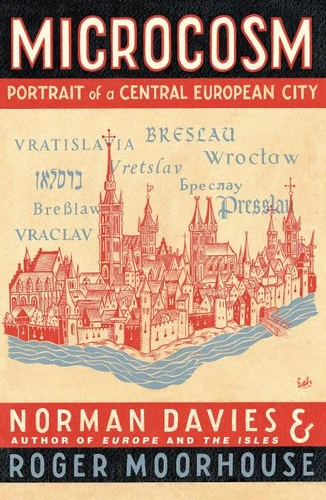
Microcosm. A Portrait of a Central European City
Par : ,Formats :
Disponible dans votre compte client Decitre ou Furet du Nord dès validation de votre commande. Le format ePub protégé est :
- Compatible avec une lecture sur My Vivlio (smartphone, tablette, ordinateur)
- Compatible avec une lecture sur liseuses Vivlio
- Pour les liseuses autres que Vivlio, vous devez utiliser le logiciel Adobe Digital Edition. Non compatible avec la lecture sur les liseuses Kindle, Remarkable et Sony
- Non compatible avec un achat hors France métropolitaine
 , qui est-ce ?
Notre partenaire de plateforme de lecture numérique où vous retrouverez l'ensemble de vos ebooks gratuitement
Pour en savoir plus sur nos ebooks, consultez notre aide en ligne ici
C'est si simple ! Lisez votre ebook avec l'app Vivlio sur votre tablette, mobile ou ordinateur :

- Nombre de pages640
- FormatePub
- ISBN978-1-4481-1408-5
- EAN9781448114085
- Date de parution31/12/2011
- Protection num.Adobe DRM
- Infos supplémentairesepub
- ÉditeurVintage Digital
Résumé
The story of Central Europe is anything but simple. As the region located between East and West, it has always been endowed with a rich variety of migrants, and has repeatedly been the scene of nomadic invasions, mixed settlements and military conquests. In order to present a portrait of Central Europe, Norman Davies and Roger Moorhouse have made a case study of one of its most colourful cities, the former German Breslau, which became the Polish Wroclaw after the Second World War.
The traditional capital of the province of Silesia rose to prominence a thousand years ago as a trading centre and bishopric in Piast Poland. It became the second city of the kingdom of Bohemia, a major municipality of the Habsburg lands, and then a Residenzstadt of the kingdom of Prussia. The third largest city of nineteenth-century Germany, its population reached one million before the bitter siege by the Soviet Army in 1945 wrought almost total destruction.
Since then Wroclaw has risen from the ruins of war and is once again a thriving regional centre. The history of Silesia's main city is more than a fascinating tale in its own right. It embodies all the experiences which have made Central Europe what it is - a rich mixture of nationalities and cultures; the scene of German settlement and of the reflux of the Slavs; a Jewish presence of exceptional distinction; a turbulent succession of imperial rulers; and the shattering exposure to both Nazis and Stalinists.
In short, it is a Central European microcosm.
The traditional capital of the province of Silesia rose to prominence a thousand years ago as a trading centre and bishopric in Piast Poland. It became the second city of the kingdom of Bohemia, a major municipality of the Habsburg lands, and then a Residenzstadt of the kingdom of Prussia. The third largest city of nineteenth-century Germany, its population reached one million before the bitter siege by the Soviet Army in 1945 wrought almost total destruction.
Since then Wroclaw has risen from the ruins of war and is once again a thriving regional centre. The history of Silesia's main city is more than a fascinating tale in its own right. It embodies all the experiences which have made Central Europe what it is - a rich mixture of nationalities and cultures; the scene of German settlement and of the reflux of the Slavs; a Jewish presence of exceptional distinction; a turbulent succession of imperial rulers; and the shattering exposure to both Nazis and Stalinists.
In short, it is a Central European microcosm.
A propos de Norman Davies
10,99 €
Europe. East & West
E-book
11,99 €
14,99 €
17,99 €
20,99 €
Europe at War
E-book
20,99 €
The Isles. A History
E-book
20,99 €
36,00 €