SOLDES
Jusqu'à -70% sur une sélection d'articles*

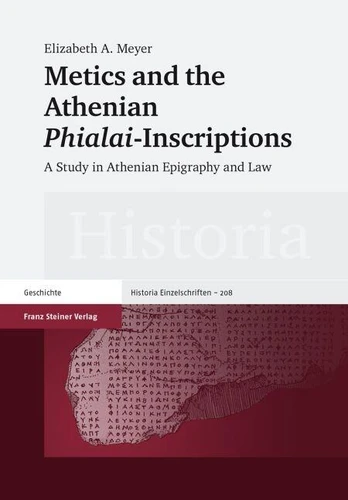
Metics and the Athenian "Phialai"-Inscriptions. A Study in Athenian Epigraphy and Law
Par :Formats :
Disponible dans votre compte client Decitre ou Furet du Nord dès validation de votre commande. Le format PDF est :
- Compatible avec une lecture sur My Vivlio (smartphone, tablette, ordinateur)
- Compatible avec une lecture sur liseuses Vivlio
- Pour les liseuses autres que Vivlio, vous devez utiliser le logiciel Adobe Digital Edition. Non compatible avec la lecture sur les liseuses Kindle, Remarkable et Sony
 , qui est-ce ?
Notre partenaire de plateforme de lecture numérique où vous retrouverez l'ensemble de vos ebooks gratuitement
Pour en savoir plus sur nos ebooks, consultez notre aide en ligne ici
C'est si simple ! Lisez votre ebook avec l'app Vivlio sur votre tablette, mobile ou ordinateur :

- Nombre de pages167
- FormatPDF
- ISBN978-3-515-12784-4
- EAN9783515127844
- Date de parution14/05/2020
- Protection num.Digital Watermarking
- Taille7 Mo
- Infos supplémentairespdf
- ÉditeurFranz Steiner
Résumé
Beneath the shining world of the citizen of Classical Athens was the perilous shadow-realm of the resident foreigner, the metic. Emblematic of the status of metic was the requirement to pay a special metic tax, the metoikion. And if a metic failed to pay this tax, he or she would be sold into slavery, a fate that threatened no citizen of the classical Athenian polis. In the late fourth century BC the Athenians, in the face of widespread departure of metics in the face of economic recession and legal harassment, moved to improve metics' legal situation in order to entice metics back to Athens.
It is to the context of these legal reforms of the metic condition, this volume argues, that a celebrated set of fourth-century BC Athenian inscriptions recording dedications of silver cups, phialai, belong.
Known since the nineteenth century as the "Attic Manumissions", these inscriptions have been thought to be the result of a legal process by which slaves were set free. Here these inscriptions are published as a corpus for the first time. And it is argued that they represent not the freeing of slaves, but preserve instead the traces of prosecutions of metics for failure to pay the metoikion. In the new pro-metic atmosphere of the 330s BC, persons who sued metics for failing to pay the metic tax, but did not win a conviction, were fined to discourage frivolous suits, and part of that fine was dedicated to divinity in the form of a phiale.
Known since the nineteenth century as the "Attic Manumissions", these inscriptions have been thought to be the result of a legal process by which slaves were set free. Here these inscriptions are published as a corpus for the first time. And it is argued that they represent not the freeing of slaves, but preserve instead the traces of prosecutions of metics for failure to pay the metoikion. In the new pro-metic atmosphere of the 330s BC, persons who sued metics for failing to pay the metic tax, but did not win a conviction, were fined to discourage frivolous suits, and part of that fine was dedicated to divinity in the form of a phiale.