


SOLDES
Jusqu'à -70% sur une sélection d'articles*
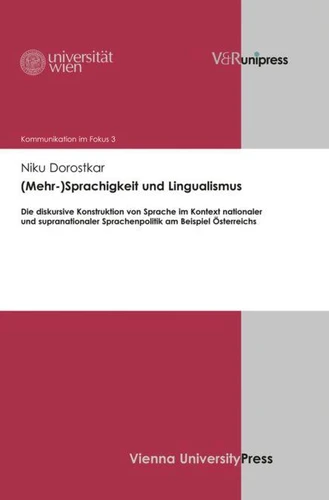
(Mehr-)Sprachigkeit und Lingualismus. Die diskursive Konstruktion von Sprache im Kontext nationaler und supranationaler Sprachenpolitik am Beispiel Österreichs
Par : , , ,Formats :
Disponible dans votre compte client Decitre ou Furet du Nord dès validation de votre commande. Le format PDF est :
- Compatible avec une lecture sur My Vivlio (smartphone, tablette, ordinateur)
- Compatible avec une lecture sur liseuses Vivlio
- Pour les liseuses autres que Vivlio, vous devez utiliser le logiciel Adobe Digital Edition. Non compatible avec la lecture sur les liseuses Kindle, Remarkable et Sony
, qui est-ce ?Notre partenaire de plateforme de lecture numérique où vous retrouverez l'ensemble de vos ebooks gratuitement
Pour en savoir plus sur nos ebooks, consultez notre aide en ligne ici
- Nombre de pages417
- FormatPDF
- ISBN978-3-8470-0163-8
- EAN9783847001638
- Date de parution20/11/2013
- Protection num.pas de protection
- Taille4 Mo
- Infos supplémentairespdf
- ÉditeurV&R Unipress
Résumé
>Multilingualism< has become one of the pivotal catchwords in a discourse which for several years has been spreading not only in the field of academics, but also in the public and private sphere, especially at the supranational European level. While the EU's language political communication efforts are aimed at the national level, the member states often seem to follow language political principles that differ significantly from those of the EU.
With this perspective in mind and focussing on an Austrian case study, the present book investigates how and to what degree the EU's discursively conducted multilingualism policy is perceived at the Austrian national level. Furthermore, it pursues the questions of how language (in the sense of >Sprachigkeit< or >languageness<) is constructed discursively in politics, the media and among citizens in Austria.
For this purpose, interviews with politicians, print media articles and focus group discussions are analysed following the discourse-historical approach with a focus on language-related nomination, predication and argumentation strategies.
With this perspective in mind and focussing on an Austrian case study, the present book investigates how and to what degree the EU's discursively conducted multilingualism policy is perceived at the Austrian national level. Furthermore, it pursues the questions of how language (in the sense of >Sprachigkeit< or >languageness<) is constructed discursively in politics, the media and among citizens in Austria.
For this purpose, interviews with politicians, print media articles and focus group discussions are analysed following the discourse-historical approach with a focus on language-related nomination, predication and argumentation strategies.


