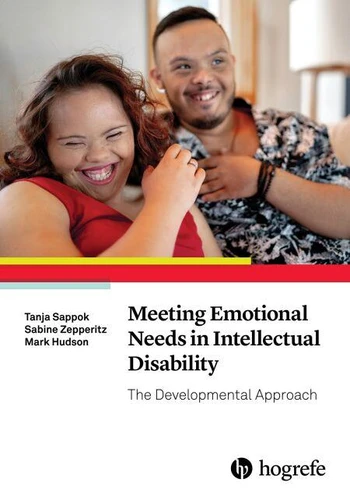
Meeting Emotional Needs in Intellectual Disability. The Developmental Approach
Par : , ,Formats :
Disponible dans votre compte client Decitre ou Furet du Nord dès validation de votre commande. Le format ePub est :
- Compatible avec une lecture sur My Vivlio (smartphone, tablette, ordinateur)
- Compatible avec une lecture sur liseuses Vivlio
- Pour les liseuses autres que Vivlio, vous devez utiliser le logiciel Adobe Digital Edition. Non compatible avec la lecture sur les liseuses Kindle, Remarkable et Sony
 , qui est-ce ?
Notre partenaire de plateforme de lecture numérique où vous retrouverez l'ensemble de vos ebooks gratuitement
Pour en savoir plus sur nos ebooks, consultez notre aide en ligne ici
C'est si simple ! Lisez votre ebook avec l'app Vivlio sur votre tablette, mobile ou ordinateur :

- Nombre de pages192
- FormatePub
- ISBN978-1-61334-589-4
- EAN9781613345894
- Date de parution24/01/2022
- Protection num.Digital Watermarking
- Taille13 Mo
- Infos supplémentairesepub
- ÉditeurHogrefe Publishing
Résumé
Help adults with intellectual disabilities improve their mental health and quality of life
- Introduces a new emotional development, evidence-based model
- Details phases and milestones of development for people with ID
- Explains challenging behaviour and mental health problems according to the model
- Detailed guidance on how to apply the approach in practice
- Full of case examples
More about the book
Using a developmental perspective, the authors offer a new, integrated model for supporting people with intellectual disability (ID).
This concept builds upon recent advances in attachment-informed approaches, by drawing upon a broader understanding of the social, emotional, and cognitive competencies of people with ID, which is grounded in developmental neuroscience and psychology. The book explores in detail how challenging behaviour and mental health difficulties in people with ID arise when their basic emotional needs are not being met by those in the environment.
Using individually tailored interventions, which complement existing models of care, practitioners can help to facilitate maturational processes and reduce behaviour that is challenging to others. As a result, the "fit" of a person within his or her individual environment can be improved. Case examples throughout the book illuminate how this approach works by targeting interventions towards the person's stage of emotional development. This book will be of interest to a wide range of professionals working with people with ID, including: clinical psychologists, psychiatrists, occupational therapists, learning disability nurses, speech and language therapists, and teachers in special education settings, as well as parents and caregivers.
This concept builds upon recent advances in attachment-informed approaches, by drawing upon a broader understanding of the social, emotional, and cognitive competencies of people with ID, which is grounded in developmental neuroscience and psychology. The book explores in detail how challenging behaviour and mental health difficulties in people with ID arise when their basic emotional needs are not being met by those in the environment.
Using individually tailored interventions, which complement existing models of care, practitioners can help to facilitate maturational processes and reduce behaviour that is challenging to others. As a result, the "fit" of a person within his or her individual environment can be improved. Case examples throughout the book illuminate how this approach works by targeting interventions towards the person's stage of emotional development. This book will be of interest to a wide range of professionals working with people with ID, including: clinical psychologists, psychiatrists, occupational therapists, learning disability nurses, speech and language therapists, and teachers in special education settings, as well as parents and caregivers.