SOLDES
Jusqu'à -70% sur une sélection d'articles*

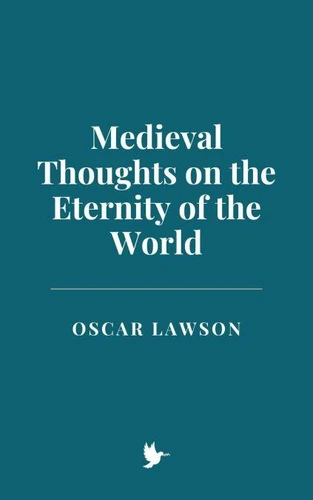
Medieval Thoughts on the Eternity of the World
Par :Formats :
Disponible dans votre compte client Decitre ou Furet du Nord dès validation de votre commande. Le format ePub est :
- Compatible avec une lecture sur My Vivlio (smartphone, tablette, ordinateur)
- Compatible avec une lecture sur liseuses Vivlio
- Pour les liseuses autres que Vivlio, vous devez utiliser le logiciel Adobe Digital Edition. Non compatible avec la lecture sur les liseuses Kindle, Remarkable et Sony
 , qui est-ce ?
Notre partenaire de plateforme de lecture numérique où vous retrouverez l'ensemble de vos ebooks gratuitement
Pour en savoir plus sur nos ebooks, consultez notre aide en ligne ici
C'est si simple ! Lisez votre ebook avec l'app Vivlio sur votre tablette, mobile ou ordinateur :

- FormatePub
- ISBN8230335764
- EAN9798230335764
- Date de parution11/01/2025
- Protection num.pas de protection
- Infos supplémentairesepub
- ÉditeurIndependently Published
Résumé
This work explores the evolution of philosophical and theological ideas surrounding the eternity of the world, divine creation, and time, tracing their development from medieval scholasticism through the Enlightenment. Beginning with the medieval debates, the text examines how thinkers like Augustine, Thomas Aquinas, and John Duns Scotus grappled with reconciling the eternal nature of God with the temporal world.
Through an analysis of key figures such as William of Ockham, who introduced nominalism, and the Renaissance philosophers like Marsilio Ficino and Giovanni Pico della Mirandola, the work highlights the shift in thought toward a more empirical and secular worldview. As the scientific revolution gained momentum, figures such as Copernicus, Kepler, Galileo, and Newton reshaped the understanding of the cosmos, moving away from theological explanations of the universe to a more mechanistic view governed by natural laws.
The Enlightenment further advanced these ideas, with thinkers like Voltaire, Rousseau, and Kant critiquing metaphysical speculations on the creation and eternity of the world, embracing a secular, reason-driven understanding of time and existence. The work underscores the tension between divine creation and natural laws, marking the transition from a theocentric universe to a more human-centered, scientific worldview.
Ultimately, the narrative traces the movement from medieval theological doctrines of time and eternity to modern philosophical and scientific thought, illustrating the profound shift in the way humanity understood its place in the cosmos and its relationship to the divine.
Through an analysis of key figures such as William of Ockham, who introduced nominalism, and the Renaissance philosophers like Marsilio Ficino and Giovanni Pico della Mirandola, the work highlights the shift in thought toward a more empirical and secular worldview. As the scientific revolution gained momentum, figures such as Copernicus, Kepler, Galileo, and Newton reshaped the understanding of the cosmos, moving away from theological explanations of the universe to a more mechanistic view governed by natural laws.
The Enlightenment further advanced these ideas, with thinkers like Voltaire, Rousseau, and Kant critiquing metaphysical speculations on the creation and eternity of the world, embracing a secular, reason-driven understanding of time and existence. The work underscores the tension between divine creation and natural laws, marking the transition from a theocentric universe to a more human-centered, scientific worldview.
Ultimately, the narrative traces the movement from medieval theological doctrines of time and eternity to modern philosophical and scientific thought, illustrating the profound shift in the way humanity understood its place in the cosmos and its relationship to the divine.
A propos de Oscar Lawson





2,99 €