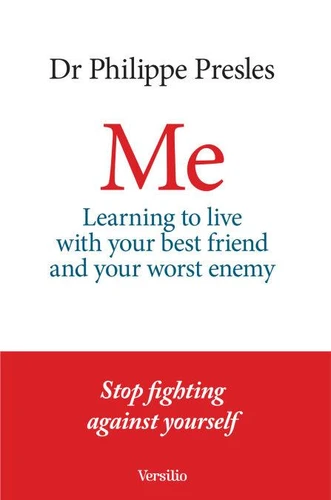
Publisher's noteEvery day, we live with ourselves, our me. It is our inner monologue, our view of the world, an inner record of our fears, our pain, our joy and our hopes. But we know precious little about this inner world, which both moulds our characters and remains, ticking over in the background, throughout the course of our lives.
This book will help you discover that your self is one of the most precious gifts of life- invented by each child since the beginnings of time.
You will come to see how our selves takes shape, like unique psychic creations, and how it allows us to be conscious of our lives and to endow them with meaning. For better or for worse.
To help each of us to enrich our lives, Philippe Presles, a trained psychotherapist, guides us through how best to discover the untapped potential of the me in all of us, drawing on developmental psychology, neuroscience, and a wealth of examples and personal experience.
You will thus discover how your self operates in many circumstances, such as extreme situations (sport, war, accidents, etc.), allowing us to surpass ourselves.
This book shows how making our me a friend rather than an enemy is an indispensable skill to living a fulfilling life and becoming our best selves.
Author's noteNeurosciences now allow us to describe how children, adults, and even animals (Macaque Rhesus monkey) gain consciousness and are thus able to recognize others like them, objects, and contexts. But we still cannot explain how humans become conscious of themselves, nor how this self-awareness sets in during childhood.
This book's central hypothesis is that to reach such a level of self-awareness, children must undergo a true psychic construction, that of their Me, which they will then project across time, as well as in imaginary situations.
By projecting themselves into the future, they conceive projects and uncover their finitude. By projecting themselves into the past, they access memories and can tell their story. By projecting themselves into their imagination, they open themselves to the world of spirituality, art, and scientific abstractions. Their Me will also allow them to observe as Other, aware of being conscious.
I have relied on both scientific studies and my personal experience in describing how this shift happens in children - this leap of consciousness - and to also explore all the consequences on our adult life (for better and worse).
This research has been my life-long passion.
The more I have studied, the more I have been struck by the fact that the philosophers - from Descartes to Heidegger, to use just two examples - who thought about the nature of our consciousness never questioned its emergence in our life, nor its development over time. Likewise, scientists would have focused more on our acquiring consciousness than on exploring our varied conscious lives (because of the limited resources allocated to research, even if these are increasingly proficient).
Finally, as a doctor and psychotherapist, I have been able to see that the relationship between our conscious makeup and our psychic suffering was of little interest to psychologists. This opened for me the entire field of reflection that makes up this book.
Publisher's noteEvery day, we live with ourselves, our me. It is our inner monologue, our view of the world, an inner record of our fears, our pain, our joy and our hopes. But we know precious little about this inner world, which both moulds our characters and remains, ticking over in the background, throughout the course of our lives.
This book will help you discover that your self is one of the most precious gifts of life- invented by each child since the beginnings of time.
You will come to see how our selves takes shape, like unique psychic creations, and how it allows us to be conscious of our lives and to endow them with meaning. For better or for worse.
To help each of us to enrich our lives, Philippe Presles, a trained psychotherapist, guides us through how best to discover the untapped potential of the me in all of us, drawing on developmental psychology, neuroscience, and a wealth of examples and personal experience.
You will thus discover how your self operates in many circumstances, such as extreme situations (sport, war, accidents, etc.), allowing us to surpass ourselves.
This book shows how making our me a friend rather than an enemy is an indispensable skill to living a fulfilling life and becoming our best selves.
Author's noteNeurosciences now allow us to describe how children, adults, and even animals (Macaque Rhesus monkey) gain consciousness and are thus able to recognize others like them, objects, and contexts. But we still cannot explain how humans become conscious of themselves, nor how this self-awareness sets in during childhood.
This book's central hypothesis is that to reach such a level of self-awareness, children must undergo a true psychic construction, that of their Me, which they will then project across time, as well as in imaginary situations.
By projecting themselves into the future, they conceive projects and uncover their finitude. By projecting themselves into the past, they access memories and can tell their story. By projecting themselves into their imagination, they open themselves to the world of spirituality, art, and scientific abstractions. Their Me will also allow them to observe as Other, aware of being conscious.
I have relied on both scientific studies and my personal experience in describing how this shift happens in children - this leap of consciousness - and to also explore all the consequences on our adult life (for better and worse).
This research has been my life-long passion.
The more I have studied, the more I have been struck by the fact that the philosophers - from Descartes to Heidegger, to use just two examples - who thought about the nature of our consciousness never questioned its emergence in our life, nor its development over time. Likewise, scientists would have focused more on our acquiring consciousness than on exploring our varied conscious lives (because of the limited resources allocated to research, even if these are increasingly proficient).
Finally, as a doctor and psychotherapist, I have been able to see that the relationship between our conscious makeup and our psychic suffering was of little interest to psychologists. This opened for me the entire field of reflection that makes up this book.

 , qui est-ce ?