SOLDES
Jusqu'à -70% sur une sélection d'articles*

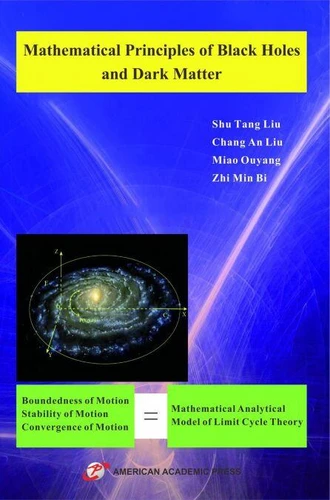
Mathematical Principles of Black Holes and Dark Matter
Par : , , ,Formats :
Disponible dans votre compte client Decitre ou Furet du Nord dès validation de votre commande. Le format ePub est :
- Compatible avec une lecture sur My Vivlio (smartphone, tablette, ordinateur)
- Compatible avec une lecture sur liseuses Vivlio
- Pour les liseuses autres que Vivlio, vous devez utiliser le logiciel Adobe Digital Edition. Non compatible avec la lecture sur les liseuses Kindle, Remarkable et Sony
 , qui est-ce ?
Notre partenaire de plateforme de lecture numérique où vous retrouverez l'ensemble de vos ebooks gratuitement
Pour en savoir plus sur nos ebooks, consultez notre aide en ligne ici
C'est si simple ! Lisez votre ebook avec l'app Vivlio sur votre tablette, mobile ou ordinateur :

- FormatePub
- ISBN8233596667
- EAN9798233596667
- Date de parution19/12/2025
- Protection num.pas de protection
- Infos supplémentairesepub
- ÉditeurLinda Balsamo
Résumé
The book fully utilizes the unique characteristics of the Milky Way: boundedness, stability, and uniform asymptotic convergence of motion. It fully uses the limit cycle theory of nonlinear dynamical systems to construct an analytic mathematical model of the Milky Way. It derives the classification of black holes, the mathematical principles of black hole formation, the analytic equilibrium equations for black hole singularities and singular cycles, the twin behavior and symmetry of black holes, and the qualitative directional theory of celestial motion inside and outside black hole walls.
From the essential connotation of dynamical behavior in mathematical systems, it presents what dark matter is, the mathematical principles of dark matter formation, the mathematical nature of dark matter, the mathematical relationship between dark matter and dark energy, dark energy generated by the mathematical driving forces of celestial motion, the relationship between system forces (natural forces) and gravity, electromagnetism, strong nuclear force, and weak nuclear force, as well as the unification of the five forces.
It also presents the semi-strange attractors of black hole dynamics, the nonlinear dynamical analysis of stellar motion in black holes, and the relationship and characterization between Lorenz chaotic attractors and the dynamical behavior of celestial bodies in the universe.
From the essential connotation of dynamical behavior in mathematical systems, it presents what dark matter is, the mathematical principles of dark matter formation, the mathematical nature of dark matter, the mathematical relationship between dark matter and dark energy, dark energy generated by the mathematical driving forces of celestial motion, the relationship between system forces (natural forces) and gravity, electromagnetism, strong nuclear force, and weak nuclear force, as well as the unification of the five forces.
It also presents the semi-strange attractors of black hole dynamics, the nonlinear dynamical analysis of stellar motion in black holes, and the relationship and characterization between Lorenz chaotic attractors and the dynamical behavior of celestial bodies in the universe.