
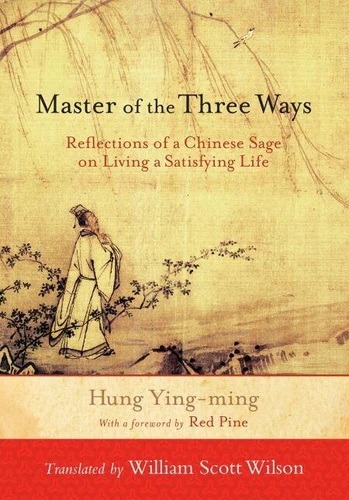
Master of the Three Ways. Reflections of a Chinese Sage on Living a Satisfying Life
Par : , ,Formats :
Disponible dans votre compte client Decitre ou Furet du Nord dès validation de votre commande. Le format ePub protégé est :
- Compatible avec une lecture sur My Vivlio (smartphone, tablette, ordinateur)
- Compatible avec une lecture sur liseuses Vivlio
- Pour les liseuses autres que Vivlio, vous devez utiliser le logiciel Adobe Digital Edition. Non compatible avec la lecture sur les liseuses Kindle, Remarkable et Sony
- Non compatible avec un achat hors France métropolitaine
 , qui est-ce ?
Notre partenaire de plateforme de lecture numérique où vous retrouverez l'ensemble de vos ebooks gratuitement
Pour en savoir plus sur nos ebooks, consultez notre aide en ligne ici
C'est si simple ! Lisez votre ebook avec l'app Vivlio sur votre tablette, mobile ou ordinateur :

- Nombre de pages224
- FormatePub
- ISBN978-0-8348-2788-2
- EAN9780834827882
- Date de parution15/05/2012
- Protection num.Adobe DRM
- Taille2 Mo
- Infos supplémentairesepub
- ÉditeurShambhala
Résumé
At once profound, spiritual, and witty, Master of the Three Ways is a remarkable work about human nature, the essence of life, and how to live simply and with awareness. In three hundred and fifty-seven verses, the author, Hung Ying-ming-a seventeenth-century Chinese sage-explores good and evil, honesty and deception, wisdom and foolishness, and heaven and hell. He draws from the wisdom of the "Three Creeds"-Taoism, Confucianism, and Zen Buddhism-to impress upon us that by combining simple elegance with the ordinary, we can make our lives artistic and poetic.
This sense, along with a particular understanding of Zen that makes art from the simple in everyday life, has permeated Chinese and Japanese culture to this day. The work is divided into two books. The first generally deals with the art of living in society and the second is concerned with man's solitude and contemplations of nature. These themes repeatedly spill over into each other, creating multiple levels of meaning.
This sense, along with a particular understanding of Zen that makes art from the simple in everyday life, has permeated Chinese and Japanese culture to this day. The work is divided into two books. The first generally deals with the art of living in society and the second is concerned with man's solitude and contemplations of nature. These themes repeatedly spill over into each other, creating multiple levels of meaning.