
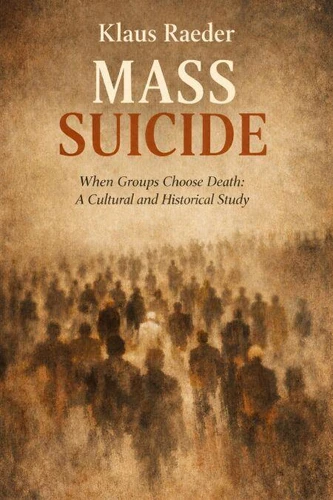
Mass Suicide
Par :Formats :
Disponible dans votre compte client Decitre ou Furet du Nord dès validation de votre commande. Le format ePub est :
- Compatible avec une lecture sur My Vivlio (smartphone, tablette, ordinateur)
- Compatible avec une lecture sur liseuses Vivlio
- Pour les liseuses autres que Vivlio, vous devez utiliser le logiciel Adobe Digital Edition. Non compatible avec la lecture sur les liseuses Kindle, Remarkable et Sony
 , qui est-ce ?
Notre partenaire de plateforme de lecture numérique où vous retrouverez l'ensemble de vos ebooks gratuitement
Pour en savoir plus sur nos ebooks, consultez notre aide en ligne ici
C'est si simple ! Lisez votre ebook avec l'app Vivlio sur votre tablette, mobile ou ordinateur :

- FormatePub
- ISBN978-3-9828303-2-2
- EAN9783982830322
- Date de parution18/01/2026
- Protection num.pas de protection
- Infos supplémentairesepub
- ÉditeurKlaus Raeder
Résumé
Why do groups of people choose death together?Mass Suicide offers the first comprehensive cultural and historical study of collective suicide across societies and historical periods. Drawing on more than 300 documented cases from antiquity to the present, the book examines how mass suicide emerges in contexts of war and siege, religious movements, colonial encounters, revolutionary upheavals, and modern cults.
Integrating a wide range of historical sources-including Greek and Roman historiography, medieval chronicles, and colonial ethnographies-with modern case studies such as Masada, Jonestown, Waco, and Heaven's Gate, the study situates collective suicide at the intersection of history, sociology, anthropology, and psychology. Classical and contemporary theories of suicide and collective behavior, including Émile Durkheim's typology and Jean Baechler's analytical framework, provide the conceptual foundation.
A central argument of the book is that collective suicide cannot be understood as a single, uniform phenomenon. Instead, it unfolds along a spectrum ranging from voluntary self-destruction to social coercion and homicide-suicide constellations. The study further explores how myths, collective memory, and so-called fables convenues have shaped historical narratives of mass death. By offering a systematic cross-cultural comparison of collective suicide from antiquity to modernity, Mass Suicide serves as a foundational reference for scholars in history, sociology, anthropology, psychology, and suicidology, as well as for readers interested in cultural history, collective violence, and the social meanings of death.
Integrating a wide range of historical sources-including Greek and Roman historiography, medieval chronicles, and colonial ethnographies-with modern case studies such as Masada, Jonestown, Waco, and Heaven's Gate, the study situates collective suicide at the intersection of history, sociology, anthropology, and psychology. Classical and contemporary theories of suicide and collective behavior, including Émile Durkheim's typology and Jean Baechler's analytical framework, provide the conceptual foundation.
A central argument of the book is that collective suicide cannot be understood as a single, uniform phenomenon. Instead, it unfolds along a spectrum ranging from voluntary self-destruction to social coercion and homicide-suicide constellations. The study further explores how myths, collective memory, and so-called fables convenues have shaped historical narratives of mass death. By offering a systematic cross-cultural comparison of collective suicide from antiquity to modernity, Mass Suicide serves as a foundational reference for scholars in history, sociology, anthropology, psychology, and suicidology, as well as for readers interested in cultural history, collective violence, and the social meanings of death.