SOLDES
Jusqu'à -70% sur une sélection d'articles*

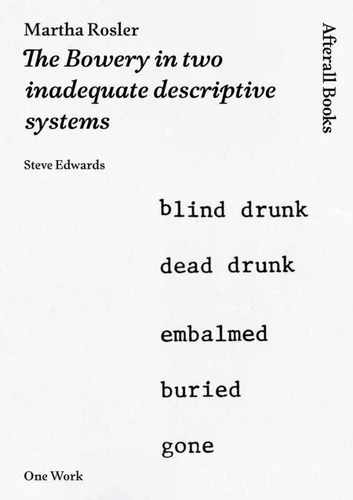
Martha Rosler. The Bowery in two inadequate descriptive systems
Par :Formats :
Disponible dans votre compte client Decitre ou Furet du Nord dès validation de votre commande. Le format ePub protégé est :
- Compatible avec une lecture sur My Vivlio (smartphone, tablette, ordinateur)
- Compatible avec une lecture sur liseuses Vivlio
- Pour les liseuses autres que Vivlio, vous devez utiliser le logiciel Adobe Digital Edition. Non compatible avec la lecture sur les liseuses Kindle, Remarkable et Sony
- Non compatible avec un achat hors France métropolitaine
 , qui est-ce ?
Notre partenaire de plateforme de lecture numérique où vous retrouverez l'ensemble de vos ebooks gratuitement
Pour en savoir plus sur nos ebooks, consultez notre aide en ligne ici
C'est si simple ! Lisez votre ebook avec l'app Vivlio sur votre tablette, mobile ou ordinateur :

- Nombre de pages112
- FormatePub
- ISBN978-1-84638-100-3
- EAN9781846381003
- Date de parution15/06/2012
- Protection num.Adobe DRM
- Taille7 Mo
- Infos supplémentairesepub
- ÉditeurAfterall Books
Résumé
The first sustained critical examination of a work by Martha Rosler that bridged the concerns of conceptual art with those of political documentary. In The Bowery in two inadequate descriptive systems (1974-1975) Martha Rosler bridged the concerns of conceptual art with those of political documentary. The work, a series of twenty-one black-and-white photographs, twenty-four text panels and three blank panels, embraces the codes of the photo-text experiments of the late 1960s and applies them to the social reality of New York's Lower East Side.
The prevailing critical view of The Bowery focuses on its implicit rejection, or critique, of established modes of documentary. In this illustrated, extended essay on the work by Rosler, Steve Edwards argues that although the critical attitude towards documentary is an important dimension of the piece, it does not exhaust the meaning of the project. Edwards situates the work in relation to debates and practices of the period, especially conceptual art and the emergence of the photo-text paradigm exemplified by the work of Robert Smithson, Bernd and Hilla Becher, Hans Haacke, Victor Burgin, and the Women and Work group.
In particular, he contextualizes Rosler's work of this period within the politicized San Diego group (which included, in addition to Rosler, Allan Sekula, Fred Lonidier, and Philip Steinmetz). Comparing The Bowery to Rosler's later video vital statistics of a citizen, simply obtained (1977) and the films of the Dziga-Vertov Group (formed by Jean-Luc Godard and Jean-Pierre Gorin), Edwards shows how the work engages with conceptual art and the neo-avant-garde of the 1960s and 1970s.
The prevailing critical view of The Bowery focuses on its implicit rejection, or critique, of established modes of documentary. In this illustrated, extended essay on the work by Rosler, Steve Edwards argues that although the critical attitude towards documentary is an important dimension of the piece, it does not exhaust the meaning of the project. Edwards situates the work in relation to debates and practices of the period, especially conceptual art and the emergence of the photo-text paradigm exemplified by the work of Robert Smithson, Bernd and Hilla Becher, Hans Haacke, Victor Burgin, and the Women and Work group.
In particular, he contextualizes Rosler's work of this period within the politicized San Diego group (which included, in addition to Rosler, Allan Sekula, Fred Lonidier, and Philip Steinmetz). Comparing The Bowery to Rosler's later video vital statistics of a citizen, simply obtained (1977) and the films of the Dziga-Vertov Group (formed by Jean-Luc Godard and Jean-Pierre Gorin), Edwards shows how the work engages with conceptual art and the neo-avant-garde of the 1960s and 1970s.