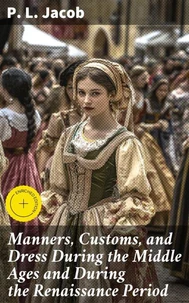
In "Manners, Customs, and Dress During the Middle Ages and During the Renaissance Period, " P. L. Jacob meticulously explores the intricate tapestry of social practices, cultural norms, and fashion that defined European society from the 5th to the 17th century. Employing a rich narrative style interwoven with vivid descriptions and scholarly insights, Jacob contextualizes each era within broader social and political frameworks.
This work serves not only as a historical account but also as a valuable resource for understanding the evolution of manners and attire, illustrating how these elements reflect shifting societal values and class structures. P. L. Jacob, a prominent historian and scholar, draws upon extensive research and primary sources to illuminate everyday life in these transformative centuries. His background in cultural history and anthropology informs his approach, allowing him to delve deeply into the interplay between social customs and economic conditions.
This scholarly rigor is evident throughout the text, as Jacob navigates through historical references, providing readers with a comprehensive look at the daily lives of individuals across various strata of society. This book is highly recommended for anyone interested in social history, fashion studies, or the cultural dynamics of the Middle Ages and Renaissance. Jacob's work is an essential addition to the libraries of both academic scholars and casual readers, offering a captivating glimpse into the past that reveals the profound influence of manners and dress on identity and social interaction.
In "Manners, Customs, and Dress During the Middle Ages and During the Renaissance Period, " P. L. Jacob meticulously explores the intricate tapestry of social practices, cultural norms, and fashion that defined European society from the 5th to the 17th century. Employing a rich narrative style interwoven with vivid descriptions and scholarly insights, Jacob contextualizes each era within broader social and political frameworks.
This work serves not only as a historical account but also as a valuable resource for understanding the evolution of manners and attire, illustrating how these elements reflect shifting societal values and class structures. P. L. Jacob, a prominent historian and scholar, draws upon extensive research and primary sources to illuminate everyday life in these transformative centuries. His background in cultural history and anthropology informs his approach, allowing him to delve deeply into the interplay between social customs and economic conditions.
This scholarly rigor is evident throughout the text, as Jacob navigates through historical references, providing readers with a comprehensive look at the daily lives of individuals across various strata of society. This book is highly recommended for anyone interested in social history, fashion studies, or the cultural dynamics of the Middle Ages and Renaissance. Jacob's work is an essential addition to the libraries of both academic scholars and casual readers, offering a captivating glimpse into the past that reveals the profound influence of manners and dress on identity and social interaction.

 , qui est-ce ?