
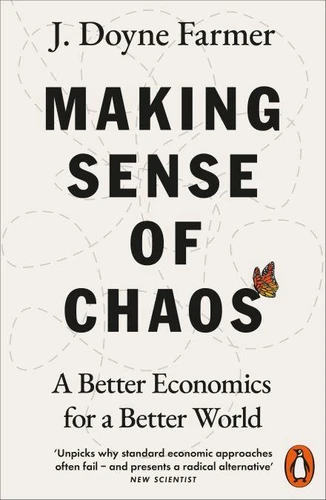



J. Doyne Farmer is an American complex systems scientist and entrepreneur who was a pioneer in many of the fields that define the scientific agenda of our times: dynamical systems, chaos, complex systems, artificial life, wearable computing, time series analysis, theoretical biology, and the theory of prediction. Currently he is Director of the Complexity Economics programme at the Institute for New Economic Thinking at the Oxford Martin School, Baillie Gifford Professor of Complex Systems Science in the school of Geography and the Environment at the University of Oxford, Senior Associate Research Fellow at Christ Church College, Chief Scientist at Macrocosm, and an External Professor at the Santa Fe Institute.
Previously, he was an Oppenheimer Fellow and the founder of the Complex Systems Group at Los Alamos National Laboratory. While a graduate student he led a cooperative calling itself Eudaemonic Enterprises who built the first wearable (and concealed) digital computer and used it in casinos, successfully beating the house. He was a founder of Prediction Company, an early quantitative automated trading firm that was sold to the United Bank of Switzerland in 2006.
His current research is in economics, including agent-based modeling, financial instability and technological progress, and a founder of Macrocosm, a new company using complexity economics to guide the green energy transition. As an adventurer and avid sailor, Doyne also finds time to enjoy sailing his boat Eudemon.
Previously, he was an Oppenheimer Fellow and the founder of the Complex Systems Group at Los Alamos National Laboratory. While a graduate student he led a cooperative calling itself Eudaemonic Enterprises who built the first wearable (and concealed) digital computer and used it in casinos, successfully beating the house. He was a founder of Prediction Company, an early quantitative automated trading firm that was sold to the United Bank of Switzerland in 2006.
His current research is in economics, including agent-based modeling, financial instability and technological progress, and a founder of Macrocosm, a new company using complexity economics to guide the green energy transition. As an adventurer and avid sailor, Doyne also finds time to enjoy sailing his boat Eudemon.