
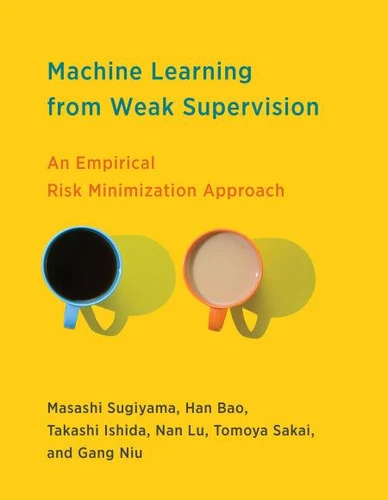
Machine Learning from Weak Supervision. An Empirical Risk Minimization Approach
Par : , , , ,Formats :
Disponible dans votre compte client Decitre ou Furet du Nord dès validation de votre commande. Le format ePub protégé est :
- Compatible avec une lecture sur My Vivlio (smartphone, tablette, ordinateur)
- Compatible avec une lecture sur liseuses Vivlio
- Pour les liseuses autres que Vivlio, vous devez utiliser le logiciel Adobe Digital Edition. Non compatible avec la lecture sur les liseuses Kindle, Remarkable et Sony
- Non compatible avec un achat hors France métropolitaine
 , qui est-ce ?
Notre partenaire de plateforme de lecture numérique où vous retrouverez l'ensemble de vos ebooks gratuitement
Pour en savoir plus sur nos ebooks, consultez notre aide en ligne ici
C'est si simple ! Lisez votre ebook avec l'app Vivlio sur votre tablette, mobile ou ordinateur :

- Nombre de pages320
- FormatePub
- ISBN978-0-262-37056-1
- EAN9780262370561
- Date de parution23/08/2022
- Protection num.Adobe DRM
- Taille24 Mo
- Infos supplémentairesepub
- ÉditeurThe MIT Press
Résumé
Fundamental theory and practical algorithms of weakly supervised classification, emphasizing an approach based on empirical risk minimization. Standard machine learning techniques require large amounts of labeled data to work well. When we apply machine learning to problems in the physical world, however, it is extremely difficult to collect such quantities of labeled data. In this book Masashi Sugiyama, Han Bao, Takashi Ishida, Nan Lu, Tomoya Sakai and Gang Niu present theory and algorithms for weakly supervised learning, a paradigm of machine learning from weakly labeled data.
Emphasizing an approach based on empirical risk minimization and drawing on state-of-the-art research in weakly supervised learning, the book provides both the fundamentals of the field and the advanced mathematical theories underlying them. It can be used as a reference for practitioners and researchers and in the classroom. The book first mathematically formulates classification problems, defines common notations, and reviews various algorithms for supervised binary and multiclass classification.
It then explores problems of binary weakly supervised classification, including positive-unlabeled (PU) classification, positive-negative-unlabeled (PNU) classification, and unlabeled-unlabeled (UU) classification. It then turns to multiclass classification, discussing complementary-label (CL) classification and partial-label (PL) classification. Finally, the book addresses more advanced issues, including a family of correction methods to improve the generalization performance of weakly supervised learning and the problem of class-prior estimation.
Emphasizing an approach based on empirical risk minimization and drawing on state-of-the-art research in weakly supervised learning, the book provides both the fundamentals of the field and the advanced mathematical theories underlying them. It can be used as a reference for practitioners and researchers and in the classroom. The book first mathematically formulates classification problems, defines common notations, and reviews various algorithms for supervised binary and multiclass classification.
It then explores problems of binary weakly supervised classification, including positive-unlabeled (PU) classification, positive-negative-unlabeled (PNU) classification, and unlabeled-unlabeled (UU) classification. It then turns to multiclass classification, discussing complementary-label (CL) classification and partial-label (PL) classification. Finally, the book addresses more advanced issues, including a family of correction methods to improve the generalization performance of weakly supervised learning and the problem of class-prior estimation.