
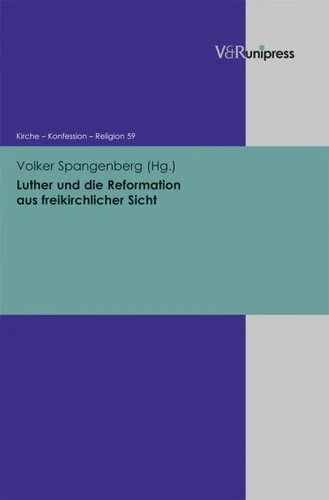
Luther und die Reformation aus freikirchlicher Sicht
Par : , , , ,Formats :
Disponible dans votre compte client Decitre ou Furet du Nord dès validation de votre commande. Le format PDF est :
- Compatible avec une lecture sur My Vivlio (smartphone, tablette, ordinateur)
- Compatible avec une lecture sur liseuses Vivlio
- Pour les liseuses autres que Vivlio, vous devez utiliser le logiciel Adobe Digital Edition. Non compatible avec la lecture sur les liseuses Kindle, Remarkable et Sony
 , qui est-ce ?
Notre partenaire de plateforme de lecture numérique où vous retrouverez l'ensemble de vos ebooks gratuitement
Pour en savoir plus sur nos ebooks, consultez notre aide en ligne ici
C'est si simple ! Lisez votre ebook avec l'app Vivlio sur votre tablette, mobile ou ordinateur :

- Nombre de pages198
- FormatPDF
- ISBN978-3-8470-0133-1
- EAN9783847001331
- Date de parution15/05/2013
- Protection num.pas de protection
- Taille1 Mo
- Infos supplémentairespdf
- ÉditeurV&R Unipress
Résumé
The upcoming anniversary of the Reformation in 2017 presents believers' church theologians with an opportunity to reflect upon their relation to the Reformation in general and Martin Luther in particular - not only from a historical but also from a present point of view. This volume includes representative articles from Baptist, Methodist and Free Evangelical perspectives. The contributions offer some surprising insights and reveal a variety of approaches to Luther and the Reformation within the different strands of the free church tradition.
To what extent can believers' churches claim to be legitimate heirs of the Reformation and, at the same time, represent a distinctly independent manifestation of evangelical Christianity? This book will serve readers from free church backgrounds in their ecumenical quest, and it will supply readers from established church backgrounds with enough material to enter into an dialog with free churches about the significance of Luther and the Reformation for today's Church.
To what extent can believers' churches claim to be legitimate heirs of the Reformation and, at the same time, represent a distinctly independent manifestation of evangelical Christianity? This book will serve readers from free church backgrounds in their ecumenical quest, and it will supply readers from established church backgrounds with enough material to enter into an dialog with free churches about the significance of Luther and the Reformation for today's Church.