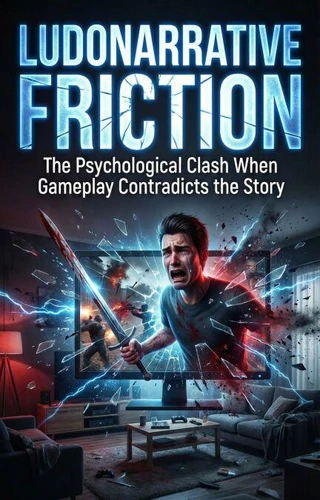
Ludonarrative Friction. The Psychological Clash When Gameplay Contradicts the Story
Par :Formats :
Disponible dans votre compte client Decitre ou Furet du Nord dès validation de votre commande. Le format ePub est :
- Compatible avec une lecture sur My Vivlio (smartphone, tablette, ordinateur)
- Compatible avec une lecture sur liseuses Vivlio
- Pour les liseuses autres que Vivlio, vous devez utiliser le logiciel Adobe Digital Edition. Non compatible avec la lecture sur les liseuses Kindle, Remarkable et Sony
 , qui est-ce ?
Notre partenaire de plateforme de lecture numérique où vous retrouverez l'ensemble de vos ebooks gratuitement
Pour en savoir plus sur nos ebooks, consultez notre aide en ligne ici
C'est si simple ! Lisez votre ebook avec l'app Vivlio sur votre tablette, mobile ou ordinateur :

- Nombre de pages147
- FormatePub
- ISBN978-3-565-26891-7
- EAN9783565268917
- Date de parution24/02/2026
- Protection num.pas de protection
- Taille717 Ko
- Infos supplémentairesepub
- ÉditeurEmphaloz Publishing House
Résumé
In modern blockbuster video games, players are frequently presented with a deeply emotional storyline. The protagonist might be portrayed as a sensitive, morally conflicted father searching for his family. Yet, the moment a cutscene ends, the player assumes control and effortlessly murders hundreds of nameless henchmen without a second thought. This jarring disconnect between a game's narrative and its actual gameplay mechanics is known as Ludonarrative Dissonance.
This deep-dive into interactive design theory explores why even the most expensive games often fail to resonate emotionally.
Coined by designer Clint Hocking, the concept exposes the critical flaw of prioritizing shooting mechanics over narrative consistency. When the actions required to "win" actively contradict the personality of the character you are playing, the psychological immersion shatters. By analyzing both massive failures and brilliant successes in game design, the book provides a masterclass on how mechanics themselves must tell the story.
You will understand why inventory limits, movement speed, and combat choices are actually the most powerful storytelling tools a developer possesses. Bridge the gap between story and system. This text is essential reading for anyone trying to understand why some virtual worlds feel alive while others feel like disjointed movie sets.
Coined by designer Clint Hocking, the concept exposes the critical flaw of prioritizing shooting mechanics over narrative consistency. When the actions required to "win" actively contradict the personality of the character you are playing, the psychological immersion shatters. By analyzing both massive failures and brilliant successes in game design, the book provides a masterclass on how mechanics themselves must tell the story.
You will understand why inventory limits, movement speed, and combat choices are actually the most powerful storytelling tools a developer possesses. Bridge the gap between story and system. This text is essential reading for anyone trying to understand why some virtual worlds feel alive while others feel like disjointed movie sets.