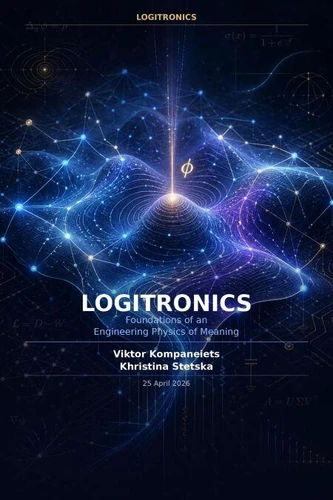
Logitronics. Foundations of an Engineering Physics of Meaning
Par : ,Formats :
Disponible dans votre compte client Decitre ou Furet du Nord dès validation de votre commande. Le format ePub est :
- Compatible avec une lecture sur My Vivlio (smartphone, tablette, ordinateur)
- Compatible avec une lecture sur liseuses Vivlio
- Pour les liseuses autres que Vivlio, vous devez utiliser le logiciel Adobe Digital Edition. Non compatible avec la lecture sur les liseuses Kindle, Remarkable et Sony
 , qui est-ce ?
Notre partenaire de plateforme de lecture numérique où vous retrouverez l'ensemble de vos ebooks gratuitement
Pour en savoir plus sur nos ebooks, consultez notre aide en ligne ici
C'est si simple ! Lisez votre ebook avec l'app Vivlio sur votre tablette, mobile ou ordinateur :

- FormatePub
- ISBN8235531314
- EAN9798235531314
- Date de parution30/04/2026
- Protection num.pas de protection
- Infos supplémentairesepub
- ÉditeurIoakim Ioakim
Résumé
"Logitronics, " authored by Viktor Kompaneiets and Khristina Stetska (2026), is a foundational scientific work that establishes a new engineering discipline. It provides a formal mathematical apparatus for modeling how "meaning" (narratives) propagates, transforms, and is stored within multi-agent systems. The authors position Logitronics as a vital bridge between classical information theory (Shannon), cybernetics (Wiener, Ashby), and the methods of mathematical physics.
The central premise of the book is that an agent's cognitive stance toward a specific narrative can be treated as a real-valued scalar potential, denoted as $phi$, defined on a Riemannian semantic manifold. This potential is mathematically derived as the "logit" of the probability $p$ that an agent accepts the narrative ($phi = ext{logit } p$). The discipline is built upon seven primitive axioms that allow the application of physical laws to the abstract domain of human communication and organizational behavior: Axiom I (Existence of the Field): Asserts that for any system containing agents and a narrative, there exists a scalar field $phi$ that is observable through the distribution of agent responses.
Axiom II (Discreteness of Meaning): Introduces the "quantum of meaning" (the Sm or semantic unit), which regularizes response data at the smallest scales. Axiom III (Conservation of Momentum): Proposes that semantic momentum in a closed system is conserved. Narratives do not simply vanish; they either propagate, decohere into "noise, " or are stored within the system's memory. Axiom IV (Uncertainty Principle): Suggests an irreducible limit on measuring an agent's position and its rate of change simultaneously.
Much like in quantum mechanics, the act of questioning an agent (measurement) inherently perturbs their cognitive state. Axiom VII (Nonlinearity at Saturation): Provides a mathematical explanation for why "fanatics" or absolute skeptics resist persuasion. As the potential $phi$ reaches extreme values, the agent's susceptibility to change drops to zero, making further persuasion impossible. Cybernetic Integration and ImpactA significant portion of the work connects Logitronics to Ashby's Law of Requisite Variety.
The authors argue that organizational "heterogeneity" (the diversity of competence and viewpoints) is not merely a social preference but a mathematical lower bound on operational viability. They prove that a team in a state of $sigma$-crisis is mathematically incapable of regulating a complex environment. OperationalizationUnlike purely theoretical or philosophical works, "Logitronics" is designed for immediate engineering application.
It includes specific protocols for measuring "logitronic posture" using surveys, behavioral data, and decision matrices. The book serves as the first in a planned series, intended for an audience of applied mathematicians, organizational designers, and operations managers. It offers a falsifiable framework-inviting scrutiny and extension-to transform the "soft" science of communication into a "hard" engineering physics of meaning.
The central premise of the book is that an agent's cognitive stance toward a specific narrative can be treated as a real-valued scalar potential, denoted as $phi$, defined on a Riemannian semantic manifold. This potential is mathematically derived as the "logit" of the probability $p$ that an agent accepts the narrative ($phi = ext{logit } p$). The discipline is built upon seven primitive axioms that allow the application of physical laws to the abstract domain of human communication and organizational behavior: Axiom I (Existence of the Field): Asserts that for any system containing agents and a narrative, there exists a scalar field $phi$ that is observable through the distribution of agent responses.
Axiom II (Discreteness of Meaning): Introduces the "quantum of meaning" (the Sm or semantic unit), which regularizes response data at the smallest scales. Axiom III (Conservation of Momentum): Proposes that semantic momentum in a closed system is conserved. Narratives do not simply vanish; they either propagate, decohere into "noise, " or are stored within the system's memory. Axiom IV (Uncertainty Principle): Suggests an irreducible limit on measuring an agent's position and its rate of change simultaneously.
Much like in quantum mechanics, the act of questioning an agent (measurement) inherently perturbs their cognitive state. Axiom VII (Nonlinearity at Saturation): Provides a mathematical explanation for why "fanatics" or absolute skeptics resist persuasion. As the potential $phi$ reaches extreme values, the agent's susceptibility to change drops to zero, making further persuasion impossible. Cybernetic Integration and ImpactA significant portion of the work connects Logitronics to Ashby's Law of Requisite Variety.
The authors argue that organizational "heterogeneity" (the diversity of competence and viewpoints) is not merely a social preference but a mathematical lower bound on operational viability. They prove that a team in a state of $sigma$-crisis is mathematically incapable of regulating a complex environment. OperationalizationUnlike purely theoretical or philosophical works, "Logitronics" is designed for immediate engineering application.
It includes specific protocols for measuring "logitronic posture" using surveys, behavioral data, and decision matrices. The book serves as the first in a planned series, intended for an audience of applied mathematicians, organizational designers, and operations managers. It offers a falsifiable framework-inviting scrutiny and extension-to transform the "soft" science of communication into a "hard" engineering physics of meaning.