
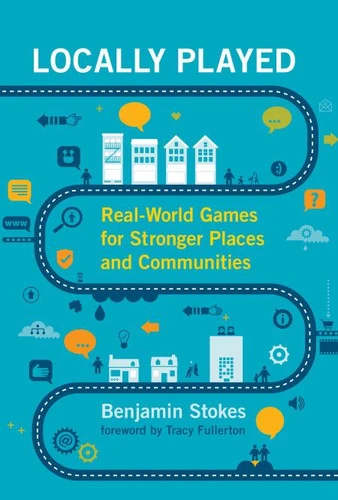
Locally Played. Real-World Games for Stronger Places and Communities
Par : ,Formats :
Disponible dans votre compte client Decitre ou Furet du Nord dès validation de votre commande. Le format ePub protégé est :
- Compatible avec une lecture sur My Vivlio (smartphone, tablette, ordinateur)
- Compatible avec une lecture sur liseuses Vivlio
- Pour les liseuses autres que Vivlio, vous devez utiliser le logiciel Adobe Digital Edition. Non compatible avec la lecture sur les liseuses Kindle, Remarkable et Sony
- Non compatible avec un achat hors France métropolitaine
 , qui est-ce ?
Notre partenaire de plateforme de lecture numérique où vous retrouverez l'ensemble de vos ebooks gratuitement
Pour en savoir plus sur nos ebooks, consultez notre aide en ligne ici
C'est si simple ! Lisez votre ebook avec l'app Vivlio sur votre tablette, mobile ou ordinateur :

- Nombre de pages288
- FormatePub
- ISBN978-0-262-35693-0
- EAN9780262356930
- Date de parution07/04/2020
- Protection num.Adobe DRM
- Taille3 Mo
- Infos supplémentairesepub
- ÉditeurThe MIT Press
Résumé
How games can make a real-world difference in communities when city leaders tap into the power of play for local impact. In 2016, city officials were surprised when Pokémon GO brought millions of players out into the public space, blending digital participation with the physical. Yet for local control and empowerment, a new framework is needed to guide the power of mixed reality and pervasive play.
In Locally Played, Benjamin Stokes describes the rise of games that can connect strangers across zip codes, support the "buy local" economy, and build cohesion in the fight for equity. With a mix of high- and low-tech games, Stokes shows, cities can tap into the power of play for the good of the group, including healthier neighborhoods and stronger communities. Stokes shows how impact is greatest when games "fit" to the local community-not just in terms of culture, but at the level of group identity and network structure.
By pairing design principles with a range of empirical methods, Stokes investigates the impact of several games, including Macon Money, where an alternative currency encouraged people to cross lines of socioeconomic segregation in Macon, Georgia; Reality Ends Here, where teams in Los Angeles competed to tell multimedia stories around local mythology; and Pokémon GO, appropriated by several cities to serve local needs through local libraries and open street festivals. Locally Played provides game designers with a model to strengthen existing networks tied to place and gives city leaders tools to look past technology trends in order to make a difference in the real world.
In Locally Played, Benjamin Stokes describes the rise of games that can connect strangers across zip codes, support the "buy local" economy, and build cohesion in the fight for equity. With a mix of high- and low-tech games, Stokes shows, cities can tap into the power of play for the good of the group, including healthier neighborhoods and stronger communities. Stokes shows how impact is greatest when games "fit" to the local community-not just in terms of culture, but at the level of group identity and network structure.
By pairing design principles with a range of empirical methods, Stokes investigates the impact of several games, including Macon Money, where an alternative currency encouraged people to cross lines of socioeconomic segregation in Macon, Georgia; Reality Ends Here, where teams in Los Angeles competed to tell multimedia stories around local mythology; and Pokémon GO, appropriated by several cities to serve local needs through local libraries and open street festivals. Locally Played provides game designers with a model to strengthen existing networks tied to place and gives city leaders tools to look past technology trends in order to make a difference in the real world.