Prof. Fabio Troncarelli studied in Rome, Paris (Ecole des Hautes Etudes), London (The Warburg Institute), Chicago (The Divinity School), and Yale (The Beinecke Library). He taught Latin Paleography at the Universities of Rome, Florence, and Viterbo. He has published several books and many articles in international journals such as Scriptorium, Revue d'Histoire des Textes, and Mediaeval Studies.
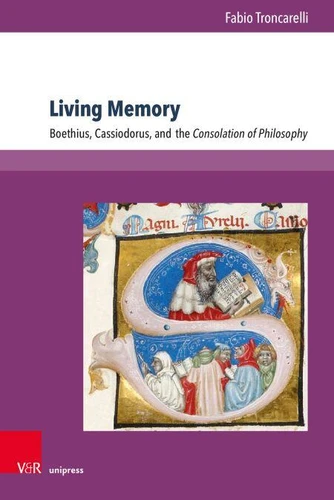
Living Memory. Boethius, Cassiodorus, and the Consolation of Philosophy
Par :Formats :
Disponible dans votre compte client Decitre ou Furet du Nord dès validation de votre commande. Le format PDF est :
- Compatible avec une lecture sur My Vivlio (smartphone, tablette, ordinateur)
- Compatible avec une lecture sur liseuses Vivlio
- Pour les liseuses autres que Vivlio, vous devez utiliser le logiciel Adobe Digital Edition. Non compatible avec la lecture sur les liseuses Kindle, Remarkable et Sony
 , qui est-ce ?
Notre partenaire de plateforme de lecture numérique où vous retrouverez l'ensemble de vos ebooks gratuitement
Pour en savoir plus sur nos ebooks, consultez notre aide en ligne ici
C'est si simple ! Lisez votre ebook avec l'app Vivlio sur votre tablette, mobile ou ordinateur :

- Nombre de pages211
- FormatPDF
- ISBN978-3-8470-1815-5
- EAN9783847018155
- Date de parution10/03/2025
- Protection num.pas de protection
- Taille11 Mo
- Infos supplémentairespdf
- ÉditeurV&R Unipress
Résumé
Fabio Troncarelli examines the Late Antique Cassiodorian edition of the "Consolation of Philosophy" by Boethius in this new study consisting of five chapters. The first one offers a brief sketch of the lives of the two protagonists of the story. The second concerns the medieval copies of the edition, some very close to the original archetype, preserving even its formal aspect, and the indication of its first transcription in Ravenna in the sixth century.
The third chapter establishes a comparison between some typical rhetorical, philosophical, and editorial methods used by Cassiodorus and the ones found in Boethius's edition. The fourth chapter explores possible reasons for Cassiodorus's decision to produce such an edition during the years of the collapse of Osthrogotic rule in Italy. The final chapter discusses the "living memory" of Boethius's reputation at Vivarium and the relationships between his murder and Amalsuintha's murder as understood and covertly preserved by the Vivarian monks.
The third chapter establishes a comparison between some typical rhetorical, philosophical, and editorial methods used by Cassiodorus and the ones found in Boethius's edition. The fourth chapter explores possible reasons for Cassiodorus's decision to produce such an edition during the years of the collapse of Osthrogotic rule in Italy. The final chapter discusses the "living memory" of Boethius's reputation at Vivarium and the relationships between his murder and Amalsuintha's murder as understood and covertly preserved by the Vivarian monks.