SOLDES
Jusqu'à -70% sur une sélection d'articles*

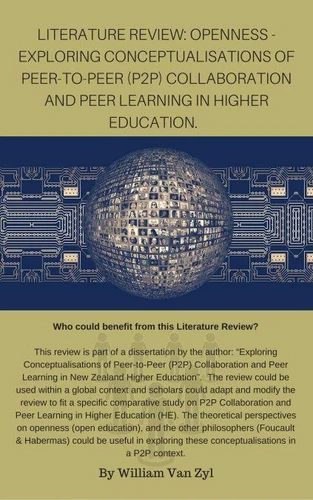
Literature Review: Openness - Exploring Conceptualisations of Peer-to-Peer (P2P) Collaboration and Peer Learning in Higher Education.
Par :Formats :
Disponible dans votre compte client Decitre ou Furet du Nord dès validation de votre commande. Le format ePub est :
- Compatible avec une lecture sur My Vivlio (smartphone, tablette, ordinateur)
- Compatible avec une lecture sur liseuses Vivlio
- Pour les liseuses autres que Vivlio, vous devez utiliser le logiciel Adobe Digital Edition. Non compatible avec la lecture sur les liseuses Kindle, Remarkable et Sony
 , qui est-ce ?
Notre partenaire de plateforme de lecture numérique où vous retrouverez l'ensemble de vos ebooks gratuitement
Pour en savoir plus sur nos ebooks, consultez notre aide en ligne ici
C'est si simple ! Lisez votre ebook avec l'app Vivlio sur votre tablette, mobile ou ordinateur :

- FormatePub
- ISBN978-0-473-43837-1
- EAN9780473438371
- Date de parution29/05/2018
- Protection num.pas de protection
- Infos supplémentairesepub
- ÉditeurIndependently Published NZ
Résumé
Abstract:Concepts of 'openness' in education hinge on interactions between individuals and organisations and boundaries within which these interactions exist. The future development of Peer-to-Peer (P2P) technologies of Higher Education rests on the critical decisions of 'openness' ('open' & 'free' education). The conceptualisations are largely influenced by those responsible for making political, economic and social decisions.
I argue that NZ is currently in a favourable position to take advantage of P2P technologies because it has the basic infrastructure to support collaborative technologies (digital interconnectivity-Web 2.0 moving into Web 3.0). This literature review explores the value of philosophical perspectives or 'foundational schools of thought on openness' from theorists such as Karl Popper, Michel Foucault, and Jürgen Habermas - which act as a measuring stick in this literature review to gauge the position of NZ HE's 'open' education within a global tertiary education context.'Openness' and the concept of 'neoliberalism' in the two main philosophical theories of Michel Foucault on Governmentality ('biopower') and Jürgen Habermas on Communicative Action are at the heart of the 'democratisation of the knowledge economy' debate.
There is no point of convergence when comparing the theory of Foucault and Habermas. Foucault is mainly concerned with providing a genealogical account of the diffusion of power (political & economical), whereas Habermas is concerned with creating a political philosophy based on the recognition of the communicative capacities of rational human beings, which Foucault neglects.... P2P technologies implemented by some OECD countries compared to NZ shows that NZ HE is utilising and implementing P2P technologies (VLE's, video, podcasts, vodcasts, microblogging, and Moodle) successfully and effectively to enhance peer teaching and learning.
I reason, with specific reference to the fundamental notion of the 'openness school of thought', that the P2P learning and teaching technologies in NZ HE are well developed, and NZ takes every opportunity to develop and refine the infrastructure and software available. The Neoliberalist ('laissez fair') approach refers to an economic system in which transactions between private parties are free from government interference such as regulations, privileges, tariffs, and subsidies (Peters, 2011; Olsen & Peters, 2005).
I reason that this approach in HE shows agendas that are seeking profit over altruism. The paradigm of education as 'social good' within the knowledge economy (knowledge to be shared) is at the heart of the philosophical approach in this paper. Peters (2011) suggests that what is required is a change in 'ethos'. "It is not the confidence and trust of the markets but rather the development of trust that comes with the radically decentered democratic collaboration that epitomises distributed knowledge, political and energy systems" (Peters, 2011, p.182).
Keywords: Peer-to-Peer Collaboration (P2P), Peer Learning (PL), Peer Assisted Learning (PAL), Openness, Neoliberalism, Post-Neoliberalism, Higher Education (HE), New Zealand (NZ), Conceptualisation, Governmentality & Biopower (Foucault), Communicative Action (Habermas), Microblogging, Twitter, and P2P Technologies.
I argue that NZ is currently in a favourable position to take advantage of P2P technologies because it has the basic infrastructure to support collaborative technologies (digital interconnectivity-Web 2.0 moving into Web 3.0). This literature review explores the value of philosophical perspectives or 'foundational schools of thought on openness' from theorists such as Karl Popper, Michel Foucault, and Jürgen Habermas - which act as a measuring stick in this literature review to gauge the position of NZ HE's 'open' education within a global tertiary education context.'Openness' and the concept of 'neoliberalism' in the two main philosophical theories of Michel Foucault on Governmentality ('biopower') and Jürgen Habermas on Communicative Action are at the heart of the 'democratisation of the knowledge economy' debate.
There is no point of convergence when comparing the theory of Foucault and Habermas. Foucault is mainly concerned with providing a genealogical account of the diffusion of power (political & economical), whereas Habermas is concerned with creating a political philosophy based on the recognition of the communicative capacities of rational human beings, which Foucault neglects.... P2P technologies implemented by some OECD countries compared to NZ shows that NZ HE is utilising and implementing P2P technologies (VLE's, video, podcasts, vodcasts, microblogging, and Moodle) successfully and effectively to enhance peer teaching and learning.
I reason, with specific reference to the fundamental notion of the 'openness school of thought', that the P2P learning and teaching technologies in NZ HE are well developed, and NZ takes every opportunity to develop and refine the infrastructure and software available. The Neoliberalist ('laissez fair') approach refers to an economic system in which transactions between private parties are free from government interference such as regulations, privileges, tariffs, and subsidies (Peters, 2011; Olsen & Peters, 2005).
I reason that this approach in HE shows agendas that are seeking profit over altruism. The paradigm of education as 'social good' within the knowledge economy (knowledge to be shared) is at the heart of the philosophical approach in this paper. Peters (2011) suggests that what is required is a change in 'ethos'. "It is not the confidence and trust of the markets but rather the development of trust that comes with the radically decentered democratic collaboration that epitomises distributed knowledge, political and energy systems" (Peters, 2011, p.182).
Keywords: Peer-to-Peer Collaboration (P2P), Peer Learning (PL), Peer Assisted Learning (PAL), Openness, Neoliberalism, Post-Neoliberalism, Higher Education (HE), New Zealand (NZ), Conceptualisation, Governmentality & Biopower (Foucault), Communicative Action (Habermas), Microblogging, Twitter, and P2P Technologies.