
Author
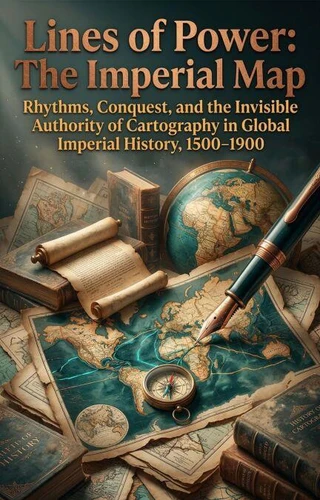
Lines of Power: The Imperial Map. Rhythms, Conquest, and the Invisible Authority of Cartography in Global Imperial History, 1500–1900
Par :Formats :
Disponible dans votre compte client Decitre ou Furet du Nord dès validation de votre commande. Le format ePub est :
- Compatible avec une lecture sur My Vivlio (smartphone, tablette, ordinateur)
- Compatible avec une lecture sur liseuses Vivlio
- Pour les liseuses autres que Vivlio, vous devez utiliser le logiciel Adobe Digital Edition. Non compatible avec la lecture sur les liseuses Kindle, Remarkable et Sony
 , qui est-ce ?
Notre partenaire de plateforme de lecture numérique où vous retrouverez l'ensemble de vos ebooks gratuitement
Pour en savoir plus sur nos ebooks, consultez notre aide en ligne ici
C'est si simple ! Lisez votre ebook avec l'app Vivlio sur votre tablette, mobile ou ordinateur :

- Nombre de pages219
- FormatePub
- ISBN978-3-565-33631-9
- EAN9783565336319
- Date de parution18/03/2026
- Protection num.pas de protection
- Taille891 Ko
- Infos supplémentairesepub
- ÉditeurEmphaloz Publishing House
Résumé
"Lines of Power: The Imperial Map" offers a provocative re-examination of the history of cartography, arguing that maps were not just tools for navigation, but powerful instruments of imperial conquest and control. This book uncovers the "lines of power" drawn by cartographers, exposing how these seemingly objective representations of space were used to legitimize land grabs, define spheres of influence, and erase indigenous populations.
It reveals the hidden mechanics of a "cartographic authority" that shaped the global political landscape. The reader will explore the shift from descriptive, pre-modern maps to precise, mathematical cartography, analyzing the role of maps in the "scramble for Africa" and other colonial expansions. The text deconstructs the political and ideological agendas embedded in maps, showing how they were used to project power and create a sense of national identity.
It is a journey into the intersection of science, art, and empire. "Lines of Power: The Imperial Map" is an essential guide for students of history, cartography, and political science. It offers a critical perspective on the power of representation, arguing that we must learn to decode the hidden agendas of the maps that have shaped our world.
It reveals the hidden mechanics of a "cartographic authority" that shaped the global political landscape. The reader will explore the shift from descriptive, pre-modern maps to precise, mathematical cartography, analyzing the role of maps in the "scramble for Africa" and other colonial expansions. The text deconstructs the political and ideological agendas embedded in maps, showing how they were used to project power and create a sense of national identity.
It is a journey into the intersection of science, art, and empire. "Lines of Power: The Imperial Map" is an essential guide for students of history, cartography, and political science. It offers a critical perspective on the power of representation, arguing that we must learn to decode the hidden agendas of the maps that have shaped our world.