
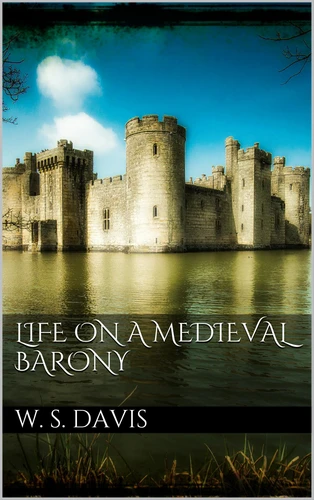
Life on a Mediaeval Barony
Par :Formats :
Disponible dans votre compte client Decitre ou Furet du Nord dès validation de votre commande. Le format ePub est :
- Compatible avec une lecture sur My Vivlio (smartphone, tablette, ordinateur)
- Compatible avec une lecture sur liseuses Vivlio
- Pour les liseuses autres que Vivlio, vous devez utiliser le logiciel Adobe Digital Edition. Non compatible avec la lecture sur les liseuses Kindle, Remarkable et Sony
 , qui est-ce ?
Notre partenaire de plateforme de lecture numérique où vous retrouverez l'ensemble de vos ebooks gratuitement
Pour en savoir plus sur nos ebooks, consultez notre aide en ligne ici
C'est si simple ! Lisez votre ebook avec l'app Vivlio sur votre tablette, mobile ou ordinateur :

- Nombre de pages454
- FormatePub
- ISBN978-3-7481-1764-3
- EAN9783748117643
- Date de parution03/12/2018
- Protection num.Digital Watermarking
- Taille7 Mo
- Infos supplémentairesepub
- ÉditeurBooks on Demand
Résumé
This book describes the life of the Feudal Ages in terms of the concrete. The discussions center around a certain seigneury of St. Aliquis. If no such barony is easily identifiable, at least there were several hundred second-grade fiefs scattered over western Christendom which were in essential particulars extremely like it, and its Baron Conon and his associates were typical of many similar individuals, a little worse or a little better, who abounded in the days of Philip Augustus.
No custom is described which does not seem fairly characteristic of the general period.
To focus the picture a specific region, northern France, and a specific year, A. D. 1220, have been selected. Not many matters have been mentioned, however, which were not more or less common to contemporaneous England and Germany; nor have many usages been explained which would not frequently have been found as early as A. D. 1100 or as late as 1300. Northern France was par excellence the homeland of Feudalism and hardly less so of Chivalry, while by general consent the years around 1220 mark one of the great turning epochs of the Middle Ages.
We are at the time of the development of French kingship under Philip Augustus, of the climax and the beginning of the waning of the crusading spirit, of the highest development of Gothic architecture, of the full blossoming of the popular Romance literature, and of the beginning of the entirely dissimilar, but even more important, Friar movement. To make the life of the Middle Ages live again in its pageantry and its squalor, its superstition and its triumph of Christian art and love, is the object of this study.
Many times has the author been reminded of the intense contrasts between sublime good and extreme evil everywhere apparent in the Feudal Epoch. With every effort at impartiality, whether praising or condemning, it is dangerously easy to write in superlatives.
To focus the picture a specific region, northern France, and a specific year, A. D. 1220, have been selected. Not many matters have been mentioned, however, which were not more or less common to contemporaneous England and Germany; nor have many usages been explained which would not frequently have been found as early as A. D. 1100 or as late as 1300. Northern France was par excellence the homeland of Feudalism and hardly less so of Chivalry, while by general consent the years around 1220 mark one of the great turning epochs of the Middle Ages.
We are at the time of the development of French kingship under Philip Augustus, of the climax and the beginning of the waning of the crusading spirit, of the highest development of Gothic architecture, of the full blossoming of the popular Romance literature, and of the beginning of the entirely dissimilar, but even more important, Friar movement. To make the life of the Middle Ages live again in its pageantry and its squalor, its superstition and its triumph of Christian art and love, is the object of this study.
Many times has the author been reminded of the intense contrasts between sublime good and extreme evil everywhere apparent in the Feudal Epoch. With every effort at impartiality, whether praising or condemning, it is dangerously easy to write in superlatives.