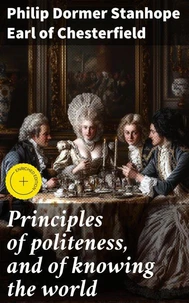
Letters to His Son, 1766-71. On the Fine Art of Becoming a Man of the World and a Gentleman
Par :Formats :
Disponible dans votre compte client Decitre ou Furet du Nord dès validation de votre commande. Le format ePub est :
- Compatible avec une lecture sur My Vivlio (smartphone, tablette, ordinateur)
- Compatible avec une lecture sur liseuses Vivlio
- Pour les liseuses autres que Vivlio, vous devez utiliser le logiciel Adobe Digital Edition. Non compatible avec la lecture sur les liseuses Kindle, Remarkable et Sony
 , qui est-ce ?
Notre partenaire de plateforme de lecture numérique où vous retrouverez l'ensemble de vos ebooks gratuitement
Pour en savoir plus sur nos ebooks, consultez notre aide en ligne ici
C'est si simple ! Lisez votre ebook avec l'app Vivlio sur votre tablette, mobile ou ordinateur :

- Nombre de pages30
- FormatePub
- ISBN859-65--4731193-5
- EAN8596547311935
- Date de parution15/09/2022
- Protection num.Digital Watermarking
- Taille339 Ko
- Infos supplémentairesepub
- ÉditeurDIGICAT
Résumé
In "Letters to His Son, 1766-71, " Philip Dormer Stanhope, the Earl of Chesterfield, offers a remarkable compendium of advice and reflections directed to his illegitimate son, reflecting a distinct blend of wit and profundity. This collection is characterized by its epistolary format, mirroring a conversational style that engages the reader while exploring themes such as education, manners, and the intricacies of social conduct in 18th-century British society.
Chesterfield's prose is imbued with a didactic tone, revealing a commitment to molding his son's character amidst the expectations of the aristocracy, thus rendering this work a seminal text in the tradition of letter writing as a means of personal and moral instruction. Chesterfield himself, born into the British nobility and raised in a world of privilege, faced the complexities of his own upbringing, which likely informed his parental philosophy.
His experiences navigating the corridors of power, diplomacy, and societal norms position him uniquely as a mentor who understood the delicate balance between personal integrity and social savvy. Chesterfield's life was marked by his ambition for his son to achieve success that transcended mere wealth and status, highlighting the enduring struggle between personal aspiration and familial duty. Readers interested in the art of letter writing, as well as those seeking insights into 18th-century social mores, will find "Letters to His Son" a poignant and instructive read.
Chesterfield's letters transcend their historical context, resonating with anyone seeking guidance on the timeless virtues of eloquence, sophistication, and moral acumen, making it a valuable addition to both literary and educational collections.
Chesterfield's prose is imbued with a didactic tone, revealing a commitment to molding his son's character amidst the expectations of the aristocracy, thus rendering this work a seminal text in the tradition of letter writing as a means of personal and moral instruction. Chesterfield himself, born into the British nobility and raised in a world of privilege, faced the complexities of his own upbringing, which likely informed his parental philosophy.
His experiences navigating the corridors of power, diplomacy, and societal norms position him uniquely as a mentor who understood the delicate balance between personal integrity and social savvy. Chesterfield's life was marked by his ambition for his son to achieve success that transcended mere wealth and status, highlighting the enduring struggle between personal aspiration and familial duty. Readers interested in the art of letter writing, as well as those seeking insights into 18th-century social mores, will find "Letters to His Son" a poignant and instructive read.
Chesterfield's letters transcend their historical context, resonating with anyone seeking guidance on the timeless virtues of eloquence, sophistication, and moral acumen, making it a valuable addition to both literary and educational collections.