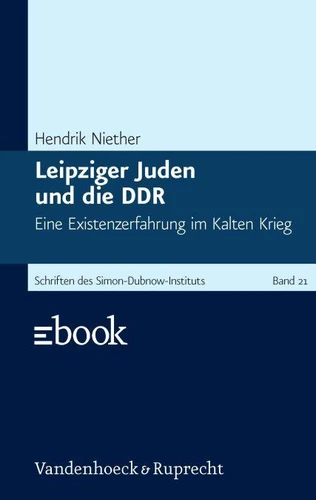
Leipziger Juden und die DDR. Eine Existenzerfahrung im Kalten Krieg
Par :Formats :
Disponible dans votre compte client Decitre ou Furet du Nord dès validation de votre commande. Le format PDF est :
- Compatible avec une lecture sur My Vivlio (smartphone, tablette, ordinateur)
- Compatible avec une lecture sur liseuses Vivlio
- Pour les liseuses autres que Vivlio, vous devez utiliser le logiciel Adobe Digital Edition. Non compatible avec la lecture sur les liseuses Kindle, Remarkable et Sony
 , qui est-ce ?
Notre partenaire de plateforme de lecture numérique où vous retrouverez l'ensemble de vos ebooks gratuitement
Pour en savoir plus sur nos ebooks, consultez notre aide en ligne ici
C'est si simple ! Lisez votre ebook avec l'app Vivlio sur votre tablette, mobile ou ordinateur :

- Nombre de pages348
- FormatPDF
- ISBN978-3-647-36997-6
- EAN9783647369976
- Date de parution19/11/2014
- Protection num.pas de protection
- Taille2 Mo
- Infos supplémentairespdf
- ÉditeurVandenhoeck & Ruprecht
Résumé
The study seeks to reconstruct the Jewish history of political experience during the period of socialism and the Cold War, as exemplified in Leipzig, the second largest city in the German Democratic Republic. It reveals that Jewish life in East Germany was not shaped solely by the formal Jewish Community (Gemeinde), but also by one's affiliation with religious and political currents, such as Reform, Orthodoxy, Zionism, socialism and communism.
The relationship of the SED party to Jewish citizens was not rigidly fixed; rather, it was characterized by a dynamic process and subject to continuous re-negotiation. Hendrik Niether demonstrates that despite the adversities of the Cold War and state repression, there was constant communication between Jews in Leipzig, emigrés from Leipzig and Jewish organizations in Western Europe, Israel and the United States.
The experience of the Holocaust constituted an element of mutual understanding between these different groups. Meanwhile, the East German society's interest in Jewish history and culture grew more pronounced as its attraction towards Antifascism ebbed away from the 1970s onward. This trend was tangible not only in ecclesial and oppositional circles, but also among political actors concerned with history and culture within the SED.
The relationship of the SED party to Jewish citizens was not rigidly fixed; rather, it was characterized by a dynamic process and subject to continuous re-negotiation. Hendrik Niether demonstrates that despite the adversities of the Cold War and state repression, there was constant communication between Jews in Leipzig, emigrés from Leipzig and Jewish organizations in Western Europe, Israel and the United States.
The experience of the Holocaust constituted an element of mutual understanding between these different groups. Meanwhile, the East German society's interest in Jewish history and culture grew more pronounced as its attraction towards Antifascism ebbed away from the 1970s onward. This trend was tangible not only in ecclesial and oppositional circles, but also among political actors concerned with history and culture within the SED.