
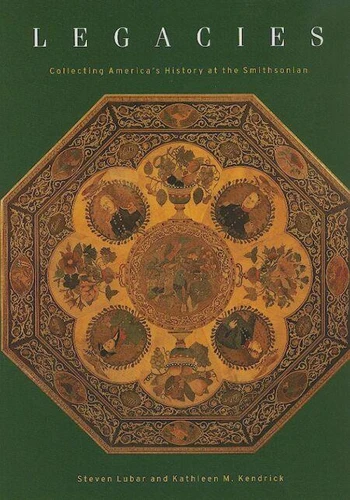
Legacies. Collecting America's History at the Smithsonian
Par : ,Formats :
Disponible dans votre compte client Decitre ou Furet du Nord dès validation de votre commande. Le format ePub protégé est :
- Compatible avec une lecture sur My Vivlio (smartphone, tablette, ordinateur)
- Compatible avec une lecture sur liseuses Vivlio
- Pour les liseuses autres que Vivlio, vous devez utiliser le logiciel Adobe Digital Edition. Non compatible avec la lecture sur les liseuses Kindle, Remarkable et Sony
- Non compatible avec un achat hors France métropolitaine
 , qui est-ce ?
Notre partenaire de plateforme de lecture numérique où vous retrouverez l'ensemble de vos ebooks gratuitement
Pour en savoir plus sur nos ebooks, consultez notre aide en ligne ici
C'est si simple ! Lisez votre ebook avec l'app Vivlio sur votre tablette, mobile ou ordinateur :

- Nombre de pages256
- FormatePub
- ISBN978-1-935623-48-9
- EAN9781935623489
- Date de parution03/06/2014
- Protection num.Adobe DRM
- Taille47 Mo
- Infos supplémentairesepub
- ÉditeurSmithsonian Institution Scholarl...
Résumé
The Smithsonian Institution has been America's museum since 1846. What do its vast collections -- from the ruby slippers to a piece of Plymouth Rock, first ladies' gowns to patchwork quilts, a Model T Ford to a customized Ford LTD low rider -- tell Americans about themselves? In this lavishly illustrated guide to the Smithsonian's National Museum of American History, Steven Lubar and Kathleen M. Kendrick tell the stories behind more than 250 of the museum's treasures, many of them never before photographed for publication.
These stories not only reveal what America as a nation has decided to save and why but also speak to changing visions of national identity. As the authors demonstrate, views of history change over time, methods of historical investigation evolve and improve, and America's understanding of the past matures. Shifts in focus and attitude lie at the hearth of Legacies, which is organized around four concepts of what a national museum of history can be: a treasure house, a shrine to the famous, a palace of progress, and a mirror of the nation.
Thus, the museum collects cherished or precious objects, houses celebrity memorabilia, documents technological advances, and reflects visitors' own lives. Taking examples from science and technology, politics, decorative arts, military history, ethnic heritage, popular culture and everyday life, the authors provide historical context for the work of the Smithsonian and shed new light on what is important, and who is included, in American history.
Throughout its history, Lubar and Kendrick conclude, the museum has played a vital role in both shaping and reflecting America's sense of itself as a nation.
These stories not only reveal what America as a nation has decided to save and why but also speak to changing visions of national identity. As the authors demonstrate, views of history change over time, methods of historical investigation evolve and improve, and America's understanding of the past matures. Shifts in focus and attitude lie at the hearth of Legacies, which is organized around four concepts of what a national museum of history can be: a treasure house, a shrine to the famous, a palace of progress, and a mirror of the nation.
Thus, the museum collects cherished or precious objects, houses celebrity memorabilia, documents technological advances, and reflects visitors' own lives. Taking examples from science and technology, politics, decorative arts, military history, ethnic heritage, popular culture and everyday life, the authors provide historical context for the work of the Smithsonian and shed new light on what is important, and who is included, in American history.
Throughout its history, Lubar and Kendrick conclude, the museum has played a vital role in both shaping and reflecting America's sense of itself as a nation.