Nouveauté
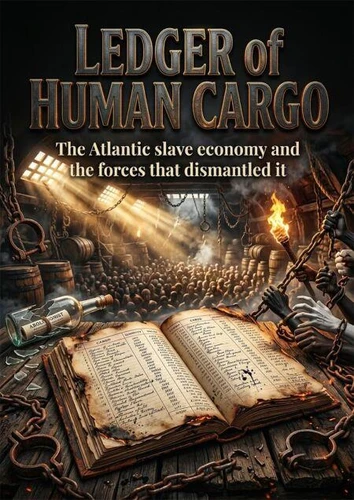
Ledger of Human Cargo. The Atlantic slave economy and the forces that dismantled it
Par :Formats :
Disponible dans votre compte client Decitre ou Furet du Nord dès validation de votre commande. Le format ePub est :
- Compatible avec une lecture sur My Vivlio (smartphone, tablette, ordinateur)
- Compatible avec une lecture sur liseuses Vivlio
- Pour les liseuses autres que Vivlio, vous devez utiliser le logiciel Adobe Digital Edition. Non compatible avec la lecture sur les liseuses Kindle, Remarkable et Sony
 , qui est-ce ?
Notre partenaire de plateforme de lecture numérique où vous retrouverez l'ensemble de vos ebooks gratuitement
Pour en savoir plus sur nos ebooks, consultez notre aide en ligne ici
C'est si simple ! Lisez votre ebook avec l'app Vivlio sur votre tablette, mobile ou ordinateur :

- Nombre de pages158
- FormatePub
- ISBN978-3-565-58772-8
- EAN9783565587728
- Date de parution26/07/2026
- Protection num.pas de protection
- Taille1 Mo
- Infos supplémentairesepub
- ÉditeurEmphaloz Publishing House
Résumé
For three centuries, the labor of enslaved Africans generated the raw materials that powered European industrial growth-sugar, cotton, tobacco, coffee. This book examines the slave economy not as a moral aberration but as a highly rationalized system of extraction that financiers, planters, and colonial administrators defended with mathematical precision. It traces how enslaved people disrupted this economy through slowdowns, sabotage, and flight, and how these everyday acts of resistance accumulated into structural pressure that made the system increasingly expensive to maintain.
The narrative then shifts to the transatlantic abolition movement, analyzing the economic calculations, diplomatic pressures, and slave revolts that converged to end the legal slave trade and later slavery itself. Rather than celebrating abolitionists alone, the book shows how the labor strike of enslaved people-refusing to produce-was the decisive factor in forcing colonial powers to restructure their economies.
It concludes by examining the economic aftermath: how former colonies built new labor systems that perpetuated inequality long after emancipation.
The narrative then shifts to the transatlantic abolition movement, analyzing the economic calculations, diplomatic pressures, and slave revolts that converged to end the legal slave trade and later slavery itself. Rather than celebrating abolitionists alone, the book shows how the labor strike of enslaved people-refusing to produce-was the decisive factor in forcing colonial powers to restructure their economies.
It concludes by examining the economic aftermath: how former colonies built new labor systems that perpetuated inequality long after emancipation.
A propos de Keira Black




24,99 €