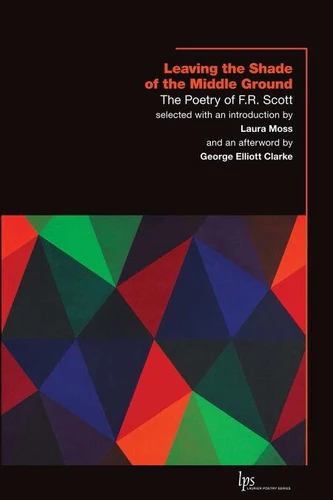



Born in 1899 in Quebec City, Francis Reginald (Frank) Scott was a public poet, an accomplished editor and mentor of a generation of writers, an influential professor of constitutional law, and a founding member of the Co-operative Commonwealth Federation (CCF). Emerging as one of the "Montreal Group" of modernist poets of the 1920s, Scott spent the next five decades writing poetry and working to transform both Canadian poetics and politics.
With a penchant for satire, Scott's work is sometimes playful and witty and sometimes gravely concerned with the legacies of political ineptitude and the fragility of both humanity and the environment. Laura Moss is an associate professor in the Department of English at the University of British Columbia and the former director of the UBC International Canadian Studies Centre. She is the associate editor of the journal Canadian Literature, co-editor (with Cynthia Sugars) of the two volume Canadian Literature in English: Texts and Contexts (2008, 2009), and the editor of Is Canada Postcolonial? Unsettling Canadian Literature (WLU Press, 2003).
George Elliott Clarke is the inaugural E. J. Pratt Professor of Canadian Literature at the University of Toronto. An expert in African-Canadian literature, he published the foundational work in the field, Odysseys Home: Mapping African-Canadian Literature, in 2002. Named a Trudeau Foundation Fellow in 2005, Clarke is also a revered poet, librettist, and novelist. For his collection Execution Poems, he received the Governor General's Award for Poetry in 2001.
His bestselling poetry-novel, Whylah Falls, is a major text in Canadian literature.
With a penchant for satire, Scott's work is sometimes playful and witty and sometimes gravely concerned with the legacies of political ineptitude and the fragility of both humanity and the environment. Laura Moss is an associate professor in the Department of English at the University of British Columbia and the former director of the UBC International Canadian Studies Centre. She is the associate editor of the journal Canadian Literature, co-editor (with Cynthia Sugars) of the two volume Canadian Literature in English: Texts and Contexts (2008, 2009), and the editor of Is Canada Postcolonial? Unsettling Canadian Literature (WLU Press, 2003).
George Elliott Clarke is the inaugural E. J. Pratt Professor of Canadian Literature at the University of Toronto. An expert in African-Canadian literature, he published the foundational work in the field, Odysseys Home: Mapping African-Canadian Literature, in 2002. Named a Trudeau Foundation Fellow in 2005, Clarke is also a revered poet, librettist, and novelist. For his collection Execution Poems, he received the Governor General's Award for Poetry in 2001.
His bestselling poetry-novel, Whylah Falls, is a major text in Canadian literature.