Learning Python with Raspberry Pi
Par :Formats :
Disponible dans votre compte client Decitre ou Furet du Nord dès validation de votre commande. Le format PDF est :
- Compatible avec une lecture sur My Vivlio (smartphone, tablette, ordinateur)
- Compatible avec une lecture sur liseuses Vivlio
- Pour les liseuses autres que Vivlio, vous devez utiliser le logiciel Adobe Digital Edition. Non compatible avec la lecture sur les liseuses Kindle, Remarkable et Sony
 , qui est-ce ?
Notre partenaire de plateforme de lecture numérique où vous retrouverez l'ensemble de vos ebooks gratuitement
Pour en savoir plus sur nos ebooks, consultez notre aide en ligne ici
C'est si simple ! Lisez votre ebook avec l'app Vivlio sur votre tablette, mobile ou ordinateur :

- Nombre de pages284
- FormatPDF
- ISBN978-1-907920-80-6
- EAN9781907920806
- Date de parution21/10/2019
- Protection num.Digital Watermarking
- Taille12 Mo
- Infos supplémentairespdf
- ÉditeurA PRECISER
Résumé
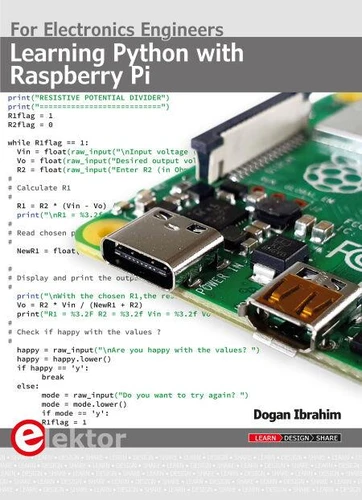
This book is about teaching the Python programming language using the Raspberry Pi 4 computer. The book makes an introduction to Raspberry Pi 4 and then teaches Python with the topics: variables, strings, arrays, matrices, tuples, lists, dictionaries, user functions, flow of control, printing, keyboard input, graphics, GUI, object oriented programming and many more topics. The book is aimed for beginners, students, practising engineers, hobbyists, and for anyone else who may want to learn to program in Python.
The book includes many example programs and case studies. All the example programs and case studies have been tested fully by the author and are all working. The example programs aim to teach the various programming concepts of Python. The case studies cover the use of Python in the analysis and design of electronic circuits. Some of the case study topics are: . Resistor colour code identification .
Resistive potential divider circuits . Resistive attenuator design . Zener diode voltage regulator design . RC and RLC transient circuits . Circuit frequency response . Saving data on external memory stick . Mesh and node circuit analysis using matrices . Resonance in RLC circuits . Transistor Biasing analysis . Transistor amplifier design . Design of active filters .
Interfacing hardware with GPIO, I2C and SPI . Using Wi-Fi with Python and TCP/IP and UDP programs . Using Bluetooth from Python Full program listings of all the programs used in the book are available at the Elektor website of the book. Readers should be able just to copy and use these programs in their Raspberry Pi projects without any modifications.
The book includes many example programs and case studies. All the example programs and case studies have been tested fully by the author and are all working. The example programs aim to teach the various programming concepts of Python. The case studies cover the use of Python in the analysis and design of electronic circuits. Some of the case study topics are: . Resistor colour code identification .
Resistive potential divider circuits . Resistive attenuator design . Zener diode voltage regulator design . RC and RLC transient circuits . Circuit frequency response . Saving data on external memory stick . Mesh and node circuit analysis using matrices . Resonance in RLC circuits . Transistor Biasing analysis . Transistor amplifier design . Design of active filters .
Interfacing hardware with GPIO, I2C and SPI . Using Wi-Fi with Python and TCP/IP and UDP programs . Using Bluetooth from Python Full program listings of all the programs used in the book are available at the Elektor website of the book. Readers should be able just to copy and use these programs in their Raspberry Pi projects without any modifications.
A propos de Dogan Ibrahim
29,99 €