
Sue Gregory, associate professor and chair of research in the School of Education at the University of New England, Australia, lectures in ICT education, conducts research on the use of virtual worlds for learning and teaching, and leads the Australia and New Zealand Virtual Worlds Working Group.
Mark J. W. Lee, adjunct senior lecturer with the School of Education at Charles Sturt University and immediate past editor-in-chief of MERLOT's Journal of Online Learning and Teaching, has broad interests in learning sciences and technology, with a current focus on creative and playful pedagogies that transcend multiple spaces, temporalities, and/or modalities.
Barney Dalgarno, Professor/Co-Director of the uImagine Digital Learning Innovation Laboratory at Charles Sturt University and co-lead editor of the Australasian Journal of Educational Technology, has received national and international recognition for his innovative research, teaching, and learning design using leading-edge technologies.
Belinda Tynan, Pro Vice-Chancellor (Learning and Teaching) at The Open University in the United Kingdom, has held management positions at higher education institutions in four countries across three continents, and over the years has attracted considerable grant funding as well as been responsible for multiple, large-scale innovation projects.
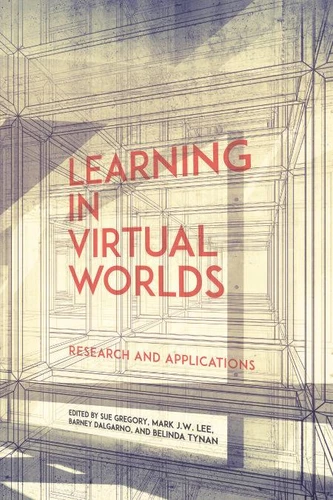
Learning in Virtual Worlds. Research and Applications
Par : , , ,Formats :
Disponible dans votre compte client Decitre ou Furet du Nord dès validation de votre commande. Le format ePub est :
- Compatible avec une lecture sur My Vivlio (smartphone, tablette, ordinateur)
- Compatible avec une lecture sur liseuses Vivlio
- Pour les liseuses autres que Vivlio, vous devez utiliser le logiciel Adobe Digital Edition. Non compatible avec la lecture sur les liseuses Kindle, Remarkable et Sony
 , qui est-ce ?
Notre partenaire de plateforme de lecture numérique où vous retrouverez l'ensemble de vos ebooks gratuitement
Pour en savoir plus sur nos ebooks, consultez notre aide en ligne ici
C'est si simple ! Lisez votre ebook avec l'app Vivlio sur votre tablette, mobile ou ordinateur :

- Nombre de pages347
- FormatePub
- ISBN978-1-77199-135-3
- EAN9781771991353
- Date de parution01/04/2016
- Protection num.Digital Watermarking
- Taille10 Mo
- Infos supplémentairesepub
- ÉditeurAU Press
Résumé
Three-dimensional (3D) immersive virtual worlds have been touted as being capable of facilitating highly interactive, engaging, multimodal learning experiences. Much of the evidence gathered to support these claims has been anecdotal but the potential that these environments hold to solve traditional problems in online and technology-mediated education-primarily learner isolation and student disengagement-has resulted in considerable investments in virtual world platforms like Second Life, OpenSimulator, and Open Wonderland by both professors and institutions.
To justify this ongoing and sustained investment, institutions and proponents of simulated learning environments must assemble a robust body of evidence that illustrates the most effective use of this powerful learning tool. In this authoritative collection, a team of international experts outline the emerging trends and developments in the use of 3D virtual worlds for teaching and learning. They explore aspects of learner interaction with virtual worlds, such as user wayfinding in Second Life, communication modes and perceived presence, and accessibility issues for elderly or disabled learners.
They also examine advanced technologies that hold potential for the enhancement of learner immersion and discuss best practices in the design and implementation of virtual world-based learning interventions and tasks. By evaluating and documenting different methods, approaches, and strategies, the contributors to Learning in Virtual Worlds offer important information and insight to both scholars and practitioners in the field. Contributors include Paul M.
Baker, Francesca Bertacchini, Leanne Cameron, Chris Campbell, Helen S. Farley, Laura Fedeli, Sue Gregory, Christopher Hardy, Bob Heller, Vicki Knox, Shailey Minocha, Jessica Pater, Margarita Pérez García, Mike Procter, Torsten Reiners, Paul Resta, Corbin Rose, Miri Shonfeld, Ann Smith, Layla F. Tabatabaie, Assunta Tavernise, Robert L. Todd, Steven Warburton, and Stephany F. Wilkes.
To justify this ongoing and sustained investment, institutions and proponents of simulated learning environments must assemble a robust body of evidence that illustrates the most effective use of this powerful learning tool. In this authoritative collection, a team of international experts outline the emerging trends and developments in the use of 3D virtual worlds for teaching and learning. They explore aspects of learner interaction with virtual worlds, such as user wayfinding in Second Life, communication modes and perceived presence, and accessibility issues for elderly or disabled learners.
They also examine advanced technologies that hold potential for the enhancement of learner immersion and discuss best practices in the design and implementation of virtual world-based learning interventions and tasks. By evaluating and documenting different methods, approaches, and strategies, the contributors to Learning in Virtual Worlds offer important information and insight to both scholars and practitioners in the field. Contributors include Paul M.
Baker, Francesca Bertacchini, Leanne Cameron, Chris Campbell, Helen S. Farley, Laura Fedeli, Sue Gregory, Christopher Hardy, Bob Heller, Vicki Knox, Shailey Minocha, Jessica Pater, Margarita Pérez García, Mike Procter, Torsten Reiners, Paul Resta, Corbin Rose, Miri Shonfeld, Ann Smith, Layla F. Tabatabaie, Assunta Tavernise, Robert L. Todd, Steven Warburton, and Stephany F. Wilkes.