
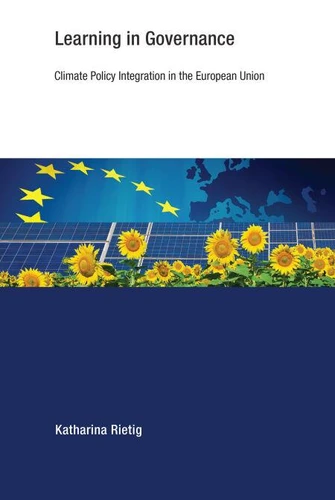
Learning in Governance. Climate Policy Integration in the European Union
Par :Formats :
Disponible dans votre compte client Decitre ou Furet du Nord dès validation de votre commande. Le format ePub protégé est :
- Compatible avec une lecture sur My Vivlio (smartphone, tablette, ordinateur)
- Compatible avec une lecture sur liseuses Vivlio
- Pour les liseuses autres que Vivlio, vous devez utiliser le logiciel Adobe Digital Edition. Non compatible avec la lecture sur les liseuses Kindle, Remarkable et Sony
- Non compatible avec un achat hors France métropolitaine
 , qui est-ce ?
Notre partenaire de plateforme de lecture numérique où vous retrouverez l'ensemble de vos ebooks gratuitement
Pour en savoir plus sur nos ebooks, consultez notre aide en ligne ici
C'est si simple ! Lisez votre ebook avec l'app Vivlio sur votre tablette, mobile ou ordinateur :

- Nombre de pages232
- FormatePub
- ISBN978-0-262-36677-9
- EAN9780262366779
- Date de parution24/08/2021
- Protection num.Adobe DRM
- Taille9 Mo
- Infos supplémentairesepub
- ÉditeurThe MIT Press
Résumé
An investigation of the role of learning and its impact on policy change, as exemplified in European Union climate policy integration. Although learning is often considered an important factor in effective environmental governance, it is not clear to what extent learning affects decision making and policy outcomes. In this book, Katharina Rietig examines the role of learning-understood as additional knowledge or experience that is taken into account by policymakers-in earth system governance and policy change.
She does this by examining learning in European Union climate policy integration, looking in detail at the examples of the Renewable Energy Directive, its controversial biofuels component, and the greening measures in the Common Agricultural Policy. To examine how learning occurs in the policy process, how to differentiate aspects of learning, and under what conditions learning matters for policy outcomes, Rietig introduces the Learning in Governance Framework, applying it to analyze the EU examples.
She finds that policy outcomes are affected through leadership of policy entrepreneurs, who use previously acquired knowledge and past experience to achieve outcomes aligned with their deeper beliefs and policy objectives. She concludes that learning does matter in governance as an intervening variable and can affect policy outcomes in combination with dedicated leadership by policy entrepreneurs who act as learning brokers.
Bargaining dominates the policymaking process among actors who represent the interests of different organizations. Rietig's theoretical framework, empirical studies, and nuanced analysis offer a new perspective on the relevance of learning in earth system governance.
She does this by examining learning in European Union climate policy integration, looking in detail at the examples of the Renewable Energy Directive, its controversial biofuels component, and the greening measures in the Common Agricultural Policy. To examine how learning occurs in the policy process, how to differentiate aspects of learning, and under what conditions learning matters for policy outcomes, Rietig introduces the Learning in Governance Framework, applying it to analyze the EU examples.
She finds that policy outcomes are affected through leadership of policy entrepreneurs, who use previously acquired knowledge and past experience to achieve outcomes aligned with their deeper beliefs and policy objectives. She concludes that learning does matter in governance as an intervening variable and can affect policy outcomes in combination with dedicated leadership by policy entrepreneurs who act as learning brokers.
Bargaining dominates the policymaking process among actors who represent the interests of different organizations. Rietig's theoretical framework, empirical studies, and nuanced analysis offer a new perspective on the relevance of learning in earth system governance.