
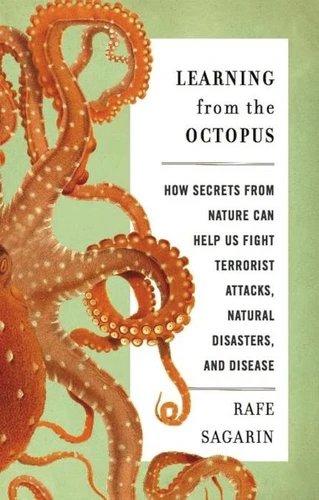
Learning From the Octopus. How Secrets from Nature Can Help Us Fight Terrorist Attacks, Natural Disasters, and Disease
Par :Formats :
Disponible dans votre compte client Decitre ou Furet du Nord dès validation de votre commande. Le format ePub protégé est :
- Compatible avec une lecture sur My Vivlio (smartphone, tablette, ordinateur)
- Compatible avec une lecture sur liseuses Vivlio
- Pour les liseuses autres que Vivlio, vous devez utiliser le logiciel Adobe Digital Edition. Non compatible avec la lecture sur les liseuses Kindle, Remarkable et Sony
- Non compatible avec un achat hors France métropolitaine
 , qui est-ce ?
Notre partenaire de plateforme de lecture numérique où vous retrouverez l'ensemble de vos ebooks gratuitement
Pour en savoir plus sur nos ebooks, consultez notre aide en ligne ici
C'est si simple ! Lisez votre ebook avec l'app Vivlio sur votre tablette, mobile ou ordinateur :

- Nombre de pages320
- FormatePub
- ISBN978-0-465-02981-5
- EAN9780465029815
- Date de parution26/03/2012
- Protection num.Adobe DRM
- Infos supplémentairesepub
- ÉditeurBasic Books
Résumé
Despite the billions of dollars we've poured into foreign wars, homeland security, and disaster response, we are fundamentally no better prepared for the next terrorist attack or unprecedented flood than we were in 2001. Our response to catastrophe remains unchanged: add another step to airport security, another meter to the levee wall. This approach has proved totally ineffective: reacting to past threats and trying to predict future risks will only waste resources in our increasingly unpredictable world.
In Learning from the Octopus, ecologist and security expert Rafe Sagarin rethinks the seemingly intractable problem of security by drawing inspiration from a surprising source: nature. Biological organisms have been living -- and thriving -- on a risk-filled planet for billions of years. Remarkably, they have done it without planning, predicting, or trying to perfect their responses to complex threats.
Rather, they simply adapt to solve the challenges they continually face. Military leaders, public health officials, and business professionals would all like to be more adaptable, but few have figured out how. Sagarinargues that we can learn from observing how nature is organized, how organisms learn, how they create partnerships, and how life continually diversifies on this unpredictable planet. As soon as we dip our toes into a cold Pacific tidepool and watch what we thought was a rock turn into an octopus, jetting away in a cloud of ink, we can begin to see the how human adaptability can mimic natural adaptation.
The same mechanisms that enabled the octopus's escape also allow our immune system to ward off new infectious diseases, helped soldiers in Iraq to recognize the threat of IEDs, and aided Google in developing faster ways to detect flu outbreaks. While we will never be able to predict the next earthquake, terrorist attack, or market fluctuation, nature can guide us in developing security systems that are not purely reactive but proactive, holistic, and adaptable.
From the tidepools of Monterey to the mountains of Kazakhstan, Sagarin takes us on an eye-opening tour of the security challenges we face, and shows us how we might learn to respond more effectively to the unknown threats lurking in our future.
In Learning from the Octopus, ecologist and security expert Rafe Sagarin rethinks the seemingly intractable problem of security by drawing inspiration from a surprising source: nature. Biological organisms have been living -- and thriving -- on a risk-filled planet for billions of years. Remarkably, they have done it without planning, predicting, or trying to perfect their responses to complex threats.
Rather, they simply adapt to solve the challenges they continually face. Military leaders, public health officials, and business professionals would all like to be more adaptable, but few have figured out how. Sagarinargues that we can learn from observing how nature is organized, how organisms learn, how they create partnerships, and how life continually diversifies on this unpredictable planet. As soon as we dip our toes into a cold Pacific tidepool and watch what we thought was a rock turn into an octopus, jetting away in a cloud of ink, we can begin to see the how human adaptability can mimic natural adaptation.
The same mechanisms that enabled the octopus's escape also allow our immune system to ward off new infectious diseases, helped soldiers in Iraq to recognize the threat of IEDs, and aided Google in developing faster ways to detect flu outbreaks. While we will never be able to predict the next earthquake, terrorist attack, or market fluctuation, nature can guide us in developing security systems that are not purely reactive but proactive, holistic, and adaptable.
From the tidepools of Monterey to the mountains of Kazakhstan, Sagarin takes us on an eye-opening tour of the security challenges we face, and shows us how we might learn to respond more effectively to the unknown threats lurking in our future.