
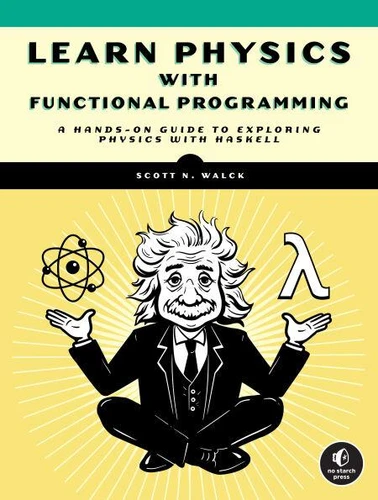
Learn Physics with Functional Programming. A Hands-on Guide to Exploring Physics with Haskell
Par :Formats :
Disponible dans votre compte client Decitre ou Furet du Nord dès validation de votre commande. Le format ePub est :
- Compatible avec une lecture sur My Vivlio (smartphone, tablette, ordinateur)
- Compatible avec une lecture sur liseuses Vivlio
- Pour les liseuses autres que Vivlio, vous devez utiliser le logiciel Adobe Digital Edition. Non compatible avec la lecture sur les liseuses Kindle, Remarkable et Sony
 , qui est-ce ?
Notre partenaire de plateforme de lecture numérique où vous retrouverez l'ensemble de vos ebooks gratuitement
Pour en savoir plus sur nos ebooks, consultez notre aide en ligne ici
C'est si simple ! Lisez votre ebook avec l'app Vivlio sur votre tablette, mobile ou ordinateur :

- Nombre de pages648
- FormatePub
- ISBN978-1-7185-0167-6
- EAN9781718501676
- Date de parution31/01/2023
- Protection num.pas de protection
- Taille26 Mo
- Infos supplémentairesepub
- ÉditeurNo Starch Press
Résumé
Deepen your understanding of physics by learning to use the Haskell functional programming language. Learn Physics with Functional Programming is your key to unlocking the mysteries of theoretical physics by coding the underlying math in Haskell. You'll use Haskell's type system to check that your code makes sense as you deepen your understanding of Newtonian mechanics and electromagnetic theory, including how to describe and calculate electric and magnetic fields.
As you work your way through the book's numerous examples and exercises, you'll learn how to: Encode vectors, derivatives, integrals, scalar fields, vector fields, and differential equations Express fundamental physical principles using the logic of Haskell's type system to clarify Newton's second law, Coulomb's law, the Biot-Savart law, and the Maxwell equations Use higher-order functions to express numerical integration and approximation methods, such as the Euler method and the finite-difference time-domain (FDTD) method Create graphs, models, and animations of physical scenarios like colliding billiard balls, waves in a guitar string, and a proton in a magnetic field Whether you're using this book as a core textbook for a computational physics course or for self-study, Learn Physics with Functional Programming will teach you how to use the power of functional programming to explore the beautiful ideas of theoretical physics.
As you work your way through the book's numerous examples and exercises, you'll learn how to: Encode vectors, derivatives, integrals, scalar fields, vector fields, and differential equations Express fundamental physical principles using the logic of Haskell's type system to clarify Newton's second law, Coulomb's law, the Biot-Savart law, and the Maxwell equations Use higher-order functions to express numerical integration and approximation methods, such as the Euler method and the finite-difference time-domain (FDTD) method Create graphs, models, and animations of physical scenarios like colliding billiard balls, waves in a guitar string, and a proton in a magnetic field Whether you're using this book as a core textbook for a computational physics course or for self-study, Learn Physics with Functional Programming will teach you how to use the power of functional programming to explore the beautiful ideas of theoretical physics.