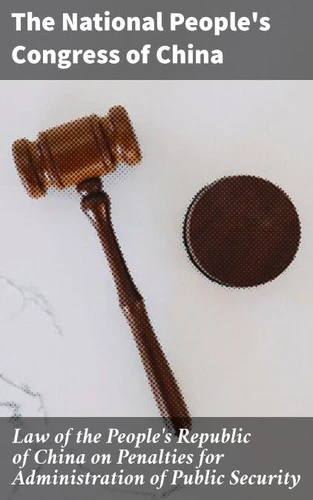
Law of the People's Republic of China on Penalties for Administration of Public Security. Understanding Chinese Public Security Penalties
Par :Formats :
Disponible dans votre compte client Decitre ou Furet du Nord dès validation de votre commande. Le format ePub est :
- Compatible avec une lecture sur My Vivlio (smartphone, tablette, ordinateur)
- Compatible avec une lecture sur liseuses Vivlio
- Pour les liseuses autres que Vivlio, vous devez utiliser le logiciel Adobe Digital Edition. Non compatible avec la lecture sur les liseuses Kindle, Remarkable et Sony
 , qui est-ce ?
Notre partenaire de plateforme de lecture numérique où vous retrouverez l'ensemble de vos ebooks gratuitement
Pour en savoir plus sur nos ebooks, consultez notre aide en ligne ici
C'est si simple ! Lisez votre ebook avec l'app Vivlio sur votre tablette, mobile ou ordinateur :

- Nombre de pages31
- FormatePub
- ISBN406-4-06-646702-9
- EAN4064066467029
- Date de parution10/04/2021
- Protection num.Digital Watermarking
- Taille311 Ko
- Infos supplémentairesepub
- ÉditeurGOOD PRESS
Résumé
The "Law of the People's Republic of China on Penalties for Administration of Public Security" represents a critical component of China's legal framework that governs public order and administrative penalties. This text provides an intricate blend of statutory provisions and practical guidance on enforcing public security regulations. Its legal style is characterized by precise language and structured organization, reflecting the broader context of Chinese administrative law while integrating traditional Confucian values of social harmony and order.
An examination of this law reveals not only its punitive measures but also the state'Äôs underlying objectives of maintaining stability and control within society. The National People's Congress of China, as the highest organ of state power, drafted this law amidst evolving sociopolitical dynamics and public demands for increased governance and legal clarity. By establishing a comprehensive regulatory framework, the authors sought to address the complexities of modern governance, balancing individual rights with collective security.
Their commitment to codifying public security measures highlights the challenges faced by lawmakers in responding to rapid urbanization and social change. This book is recommended for legal scholars, policymakers, and students of Chinese law, providing vital insights into the mechanisms of public security enforcement in China. It serves as an essential resource for understanding the intricate balance between law, order, and social governance in a contemporary context.
An examination of this law reveals not only its punitive measures but also the state'Äôs underlying objectives of maintaining stability and control within society. The National People's Congress of China, as the highest organ of state power, drafted this law amidst evolving sociopolitical dynamics and public demands for increased governance and legal clarity. By establishing a comprehensive regulatory framework, the authors sought to address the complexities of modern governance, balancing individual rights with collective security.
Their commitment to codifying public security measures highlights the challenges faced by lawmakers in responding to rapid urbanization and social change. This book is recommended for legal scholars, policymakers, and students of Chinese law, providing vital insights into the mechanisms of public security enforcement in China. It serves as an essential resource for understanding the intricate balance between law, order, and social governance in a contemporary context.