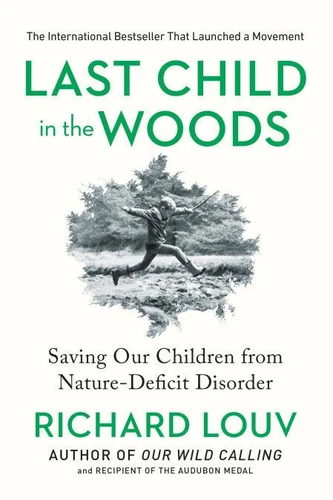
The Book That Launched an International Movement Fans of The Anxious Generation will adore Last Child in the Woods, Richard Louv's groundbreaking New York Times bestseller. "An absolute must-read for parents." -The Boston Globe "It rivals Rachel Carson's Silent Spring." -The Cincinnati Enquirer "I like to play indoors better 'cause that's where all the electrical outlets are, " reports a fourth grader.
But it's not only computers, television, and video games that are keeping kids inside. It's also their parents' fears of traffic, strangers, Lyme disease, and West Nile virus; their schools' emphasis on more and more homework; their structured schedules; and their lack of access to natural areas. Local governments, neighborhood associations, and even organizations devoted to the outdoors are placing legal and regulatory constraints on many wild spaces, sometimes making natural play a crime.
As children's connections to nature diminish and the social, psychological, and spiritual implications become apparent, new research shows that nature can offer powerful therapy for such maladies as depression, obesity, and attention deficit disorder. Environment-based education dramatically improves standardized test scores and grade-point averages and develops skills in problem solving, critical thinking, and decision making.
Anecdotal evidence strongly suggests that childhood experiences in nature stimulate creativity. In Last Child in the Woods, Louv talks with parents, children, teachers, scientists, religious leaders, child-development researchers, and environmentalists who recognize the threat and offer solutions. Louv shows us an alternative future, one in which parents help their kids experience the natural world more deeply-and find the joy of family connectedness in the process.
Included in this edition: A Field Guide with 100 Practical Actions We Can Take Discussion Points for Book Groups, Classrooms, and Communities Additional Notes by the Author New and Updated Research from the U. S. and Abroad
The Book That Launched an International Movement Fans of The Anxious Generation will adore Last Child in the Woods, Richard Louv's groundbreaking New York Times bestseller. "An absolute must-read for parents." -The Boston Globe "It rivals Rachel Carson's Silent Spring." -The Cincinnati Enquirer "I like to play indoors better 'cause that's where all the electrical outlets are, " reports a fourth grader.
But it's not only computers, television, and video games that are keeping kids inside. It's also their parents' fears of traffic, strangers, Lyme disease, and West Nile virus; their schools' emphasis on more and more homework; their structured schedules; and their lack of access to natural areas. Local governments, neighborhood associations, and even organizations devoted to the outdoors are placing legal and regulatory constraints on many wild spaces, sometimes making natural play a crime.
As children's connections to nature diminish and the social, psychological, and spiritual implications become apparent, new research shows that nature can offer powerful therapy for such maladies as depression, obesity, and attention deficit disorder. Environment-based education dramatically improves standardized test scores and grade-point averages and develops skills in problem solving, critical thinking, and decision making.
Anecdotal evidence strongly suggests that childhood experiences in nature stimulate creativity. In Last Child in the Woods, Louv talks with parents, children, teachers, scientists, religious leaders, child-development researchers, and environmentalists who recognize the threat and offer solutions. Louv shows us an alternative future, one in which parents help their kids experience the natural world more deeply-and find the joy of family connectedness in the process.
Included in this edition: A Field Guide with 100 Practical Actions We Can Take Discussion Points for Book Groups, Classrooms, and Communities Additional Notes by the Author New and Updated Research from the U. S. and Abroad

 , qui est-ce ?